After more than six months of driving the 2027 Bolt, I feel comfortable with the car and have made all the adjustments necessary for the car to work the way I want it to.
The software that controls the interface between the driver and the vehicle in modern cars is complex. Despite skimming the manual and paging through various menus I often tolerated GM’s defaults that I found unsatisfactory until discovering the solution from a post on ChevyBolt.org. (My thanks to the forum users for their helpful posts.)
Reading Battery Data
With Nissan’s Leaf I used Leaf Spy to read the car’s battery data and other parameters. With the first generation Bolt, I used Torque Pro and OBD-II PIDS (Parameter IDs) deciphered by Sean Graham. (See Peeking Inside the Bolt’s Brain Reveals Valuable Secrets.) Setting up Torque Pro with specific PIDs was at the limit of my skills, but it worked—at least on the first generation Bolts.
The 2027 Bolt required a new approach as Torque Pro no longer worked. My dealer pointed me to a Youtube video by the Average EV on how to use an OBD dongle on a Chevy Equinox. I then used OBDLink CX for the OBD dongle and Car Scanner ELM OBD2 for interpreting data from the car. (See 2027 Chevy Bolt Reading Car Scanner ELM OBD2.)

Approach Detection
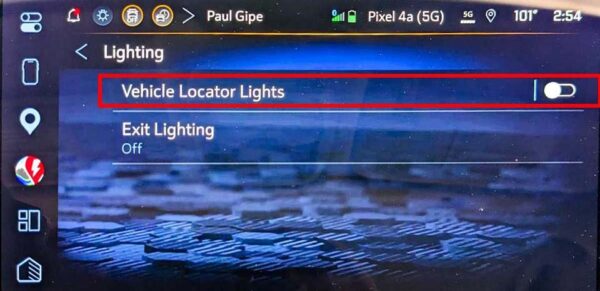
One of the most annoying default features of the 2027 Bolt is “approach detection.” My habit is to wear the key fob on my belt when I dress in the morning. We park our new Bolt in the car port next to the kitchen. Thus, the car would “detect” the fob whenever I walked into the kitchen, turning on the headlights and driver’s display. The car would eventually turn itself off, but the experience was annoying in that I want the car “on” when I want it “on” not when the car thinks I want it “on.”
I accommodated the car by leaving my keys in the house. And, as you would expect, when I went to get in the car to drive somewhere, the keys were often still in the house. Again, thanks to the denizens of ChevyBolt.org I was directed to the submenu where I could turn off this annoying feature under “Vehicle Locator Lights.” (See 2027 Bolt Tips for Beginners and Newbies.)
One-Pedal Drive
One of the great advantages of an EV is “one-pedal” driving. It seems archaic to drive any other way now. So a lot of Bolt fans were miffed that GM–in its infinite wisdom–eliminated the “regen-on-demand” paddle on the steering wheel in the new Bolt.
Upon delivery of the 2027 Bolt, I immediately set regen to max and it’s worked fine ever since. Admittedly, there have been times when I’ve reached for the regen-on-demand paddle out of habit, but the native regen is equivalent to the old Bolt and will bring the car to a halt quickly. For the most part, the native regen is more than adequate.
Efficiency
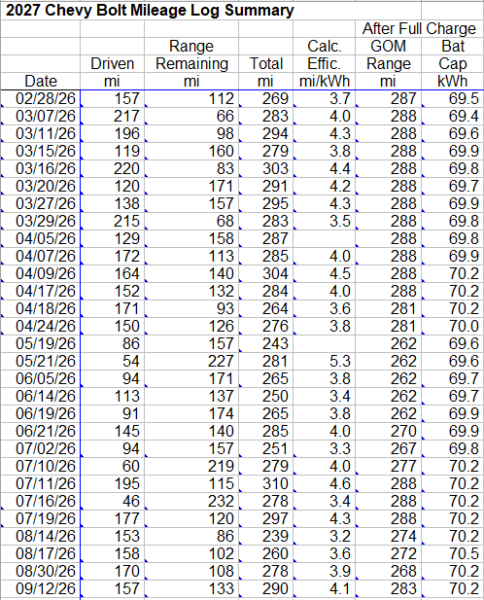
The average local and highway driving efficiency over nearly four years of the 2020 Bolt with a new battery was ~4.4 mi/kWh. The 2027 Bolt after more than six months and 9,300 miles of combined driving has an average efficiency of ~3.9 mi/kWh or about 10% less than the first generation Bolt. I arrived at the average efficiency from my own records and confirmed that with the My Chevy app’s vehicle status. The efficiency of the 2027 Bolt at freeway speeds appears comparable to first generation Bolts as does the efficiency of driving the Bolt at low speeds on mountain roads. (See 2027 Chevy Bolt Matches Bakersfield to Horse Meadow Efficiency, and 2027 Chevy Bolt Bakersfield to Bald Mountain Efficiency Bests 2017 Bolt).
Odd Noise Repair
I first publicly reported on the odd noise from the Bolt in mid-April 2026. I had notified GM earlier. (See 2027 Chevy Bolt Odd Noise at Low Power Levels.) In early July I reported on GM’s replacement of our car’s drive motor to fix my complaint about the noise. (See Its Back: GM Fixed Our 2027 Chevy Bolt’s Noise Issue.) At the time, I wrote that GM had fixed the noise issue. My current view is more nuanced after driving the 2027 Bolt ~2,000 miles since the repair.
The odd noise that I reported has been substantially reduced. It has not been eliminated.
The volume of the noise and its occurrence has been greatly reduced. However, once sensitized to the noise, it is still noticeable at certain speeds and conditions. It is subtle, very subtle, but noticeable if you’re listening for it.
I may have noticed a similar noise in the 2024 Chevy Blazer AWD RS that Three-Way Chevrolet provided as a rental. Again, the noise is very subtle, but noticeable under certain conditions if you’re listening for it. The noise may be related to the motor common between the Blazer, Equinox, and Bolt.
The 2027 Bolt is otherwise perfectly serviceable and I suspect most drivers will never notice this noise, especially drivers new to EVs. Nancy, my wife, doesn’t notice it.
Disclosure: I worked for GM’s Delco-Remy division from 1968-1970. I’ve also professionally measured traffic and ambient noise and the noise from small wind turbines so I may be more aware of noise emissions than most.
During most driving conditions, the noise is masked by tire noise and wind noise.
On recent long-distance, high-speed trips, the noise was most noticeable from 70 mph to 80 mph at power levels of -20 kW to 30 kW.
I would classify the odd noise as now “acceptable” and not overly annoying. However, we never experienced a similar noise in the 7.5 years of driving two different first generation Bolt models (2017 & 2020).
OTAs & Energy Pass
The future of EVs is the convenience of simply plugging your car into a fast charger and the charge beginning immediately without the need for apps, credit cards, or RFID cards. We’re not there yet with non-Tesla vehicles, but we’re close.
Our 2027 Bolt and our 2020 Bolt have both successfully charged automatically at an Ionna station. I don’t know if Ionna uses “plug & charge” or some other integration system—and I don’t care. It works, it’s painless, and it’s the height of convenience.
We’ve also used EVgo’s “Autocharge” on both vehicles. And while it’s complicated to set up, once that’s done it rivals the simplicity of true “plug & charge.” Again, as a driver it looks like “plug & charge” to the customer and it simply works.
One of the promised features of the 2027 Bolt is its ability to “plug & charge” at Tesla supercharger stations. This eliminates the need for the Tesla app at V3 dispensers and the app, credit card, or GM’s Energy Pass at V4 dispensers.
The Over-the-Air update was promised during the summer of 2026. So I was elated on 18 August 2026 when the Bolt received OTA “Infotainment 2026.3.”
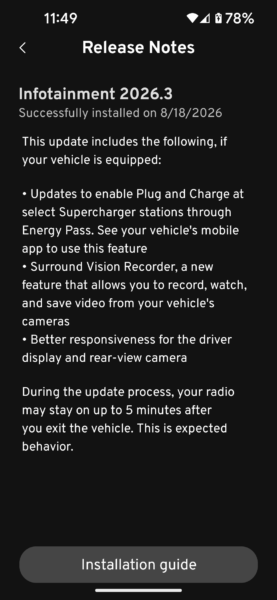
After installing the OTA successfully, I couldn’t wait to try it at the nearest Tesla Supercharger station. Thus began a series of frustrating encounters with Tesla superchargers and GM. The OTA also reset the car’s infotainment software to the defaults, requiring me to go through the menus once again setting the software to my preferences.
Here’s what happened when I went to charge at Tesla’s Grocery Outlet location in Oildale, California. After plugging in, nothing would happen, and then the car’s DIC would say there was an error and try another cord. This sequence would then repeat. In the meantime the charge cord was locked into the car’s charge port, necessitating a series of opening and closing the driver’s door, and turning the car off and on until the cable was released.
I filed a complaint with GM’s EV concierge. The concierge reset the credit card info in the My Chevy Energy Pass. Off again to Oildale to rinse and repeat. It still didn’t work.
On a trip to the Bay Area earlier this year we stopped at the big Tesla station at Harris Ranch. The station there used V3 dispensers without credit card readers, so I pulled up the “Charge Assist” screen, found the station, identified the dispenser, and told the car to start charging through Energy Pass. It did! I was impressed. I didn’t have to use the Tesla app anymore—or so I thought then.
Post the OTA update, we took a road trip up the east side of the Sierra’s where a stop at the Tesla station at Coso Junction was called for. Once we arrived, I called up the Charge Assist screen, found the station and the dispenser number, and told the car to start charging. Bang. I immediately got an error message that my credit card was declined. I was then on the phone for 18 minutes with the EV Concierge with no luck. Fortunately, these were V4 dispensers with credit card readers so I got out and used my credit card—the very one that GM’s Energy Pass was declining. So now it appeared that not only was plug & charge not working, the OTA had screwed up Energy Pass.
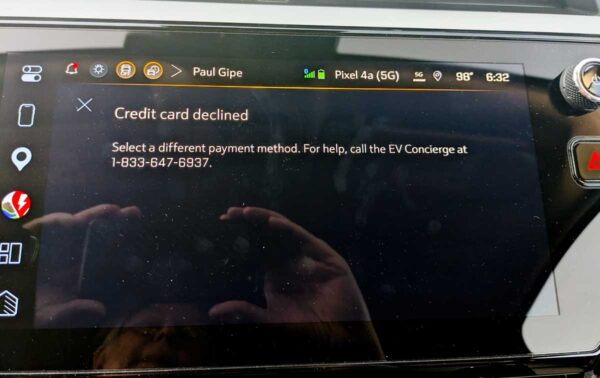
A few weeks later, I thought I’d give GM another chance in hopes that they had mysteriously straightened out whatever they’d messed up. Back over to Oildale where I plugged in, the car beeped, and it started charging 1 kW then 2 kW, and I was just about to shout for joy when another error message popped up and said try another cord. So I did. Same sequence, so I tried to use Energy Pass through the car. Again, credit card declined, but now the charge port was locked and I had to fart around to get it unlocked before I could drive home.
Now I was concerned. I had another long distance trip coming up where a stop at Tesla station with V3 dispensers was planned. This forced me to test whether the Tesla app would still work. Across town I went to an older Tesla supercharger station with V3 dispensers. I plugged in. Again, no plug & charge initiation. Again, credit card declined through Energy Pass. Then I pulled up the Tesla app, hallelujah, the app still worked.
In short, a month after the OTA there’s no “plug & charge” with Tesla, and worse Energy Pass no longer works at all with Tesla’s superchargers. It may not work with Ionna too. I won’t know until our next long-distance trip.
Update 23 September 2026: I successfully started a charge at the Telsa station in Oildale (Grocery Outlet). Hallelujah! Prior to arriving at the station, I made a new credit card entry in Energy Pass. Everything remained the same except my name. For the new entry, I included my middle name, which is shown on my credit card. This hadn’t been necessary before, but it appears this was what was needed. I also entered my debit card as well, but it wasn’t needed.
MSRP & Value
At the time I was looking for the new Bolt, no dealers were offering discounts off MSRP. Worse, some dealers were loading new Bolts with additional markups. We were only interested in the base model, the LT, with the comfort and convenience package. I long ago learned that all EVs should have a heated steering wheel and heated front seats. It’s the only way to go even in California.
We would pay no more than MSRP that was a given. So I searched for a dealer who would quote the LT with the conference and convenience package and all taxes and fees. In other words, we would only consider an “out-the-door” price. As in the past the local Bakersfield dealer couldn’t meet even these simple requirements and we bought the 2027 Bolt for $33,000 from a dealer in Glendale, California. We offered to pay them $500 to ship the car to Bakersfield. We’d had our first EV delivered to Bakersfield so we were comfortable with the process.
All transactions were done by email and telephone.
A few days later I was surprised when the young salesman called and said that he’d arrive shortly with our car. He and a colleague drove the car up from LA and we handled all payment and transfer of ownership at our kitchen table. It was the most effortless transaction yet.
Subsequently, I put our 2020 Bolt LT on the market. I did not trade it in. Recurrent estimated that the car was worth from $9,500 to $12,000. CarMax bid $7,200 for the 2020 Bolt with 55,000 miles on the odometer, but with only 33,000 miles on a new battery. Kelley Blue Book bid $8,200 through the local Ford dealer. Carvana bested them both by far with a bid for $10,400. We went with Carvana and the transaction was as simple as buying the Bolt.
So the net cost to us was ~$23,000 about what we paid—with San Joaquin Valley APCD subsidies—for the 2020 Bolt that we had to pick up in San Diego, a couple of hundred miles from Bakersfield.
All in all, the car buying and selling transactions were the simplest yet. And the overall cost of the vehicle was what we were willing to pay.
Was it worth it? Yes. We could have paid less if we’d waited a few months, but instead we got to drive the car during those few months when we were traveling most. And the faster DCFC charging made a huge difference on our road trips. We have hardly enough time to go to the toilet before the car was finished charging.
We also learned that the 2027 Bolt is more car than GM was touting. The battery is nearly 8% bigger than advertised (70 kWh vs 65 kWh) and the range was accordingly greater.
The Monroney sticker lists the mpg for city, highway, and combined driving (120 mpg) but only the range for combined driving: 262 miles.
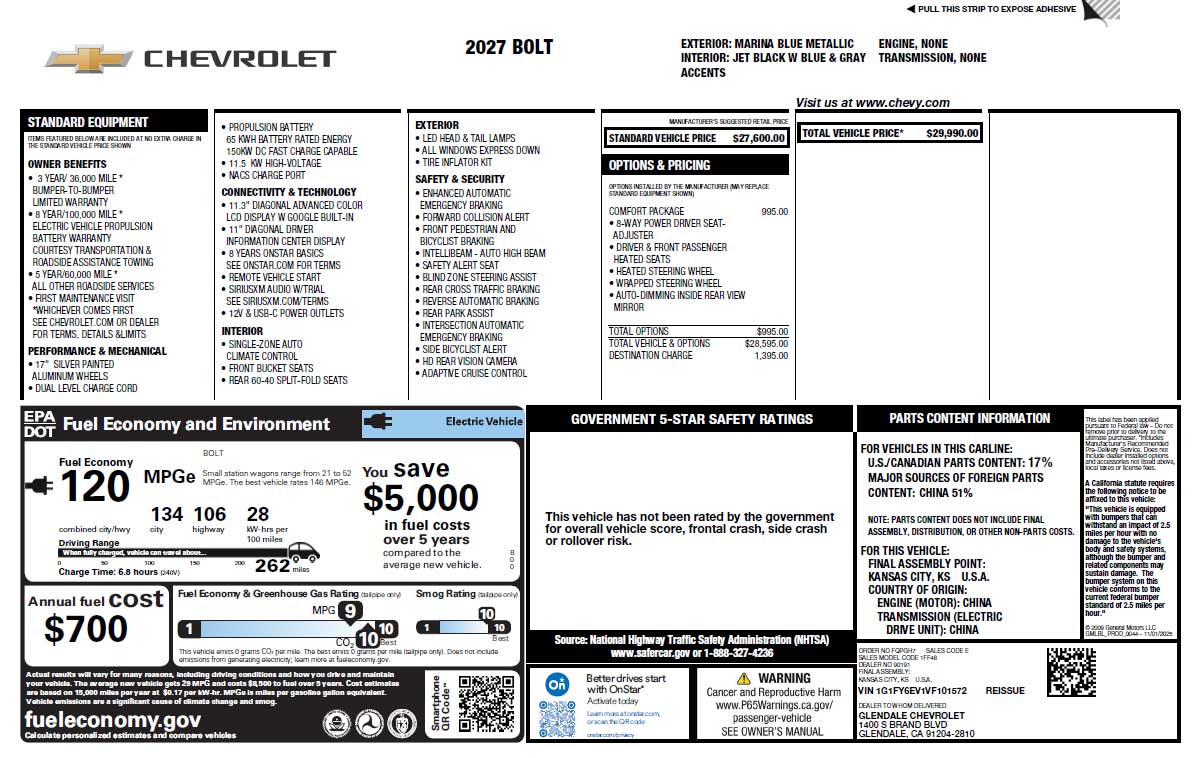
EPA’s city efficiency for the Bolt is 134 mpg or the equivalent of 4 mi/kWh. With a 70 kWh battery, city range is therefore about 280 miles. At low speed mountain driving, we got an efficiency of from 4.4 mi/kWh to 4.6 mi/kWh giving us a theoretical range of more than 300 miles.
In Edmunds testing, they got a range comparable to our results of 290 miles. (see Tested: 2027 Chevy Bolt Almost Hits 300 Miles of Real-World Range.)
The car was assembled by the UAW in Kansas City, but 51% of the vehicle’s content was made in China due to the battery and drive train.
Disclosure: I was a former member of the UAW as a member of the National Writer’s Union.
We are generally satisfied with the car. It does what we want it to do for what we wanted to spend. It was the cheapest new EV on the market with the features we wanted.
There’s always the risk of confirmation bias because we paid more for the car than it can currently be purchased for. We bought it when we did for the reasons stated. We don’t have any regrets.
Now if GM can just get that plug & charge feature working. . .
Update 23 September 2026: I successfully started a charge at the Telsa station in Oildale (Grocery Outlet). Hallelujah! Prior to arriving at the station, I made a new credit card entry in Energy Pass. Everything remained the same except my name. For the new entry, I included my middle name, which is shown on my credit card. This hadn’t been necessary before, but it appears this was what was needed. I also entered my debit card as well, but it wasn’t needed.
- 2027 Bolt Tips for Beginners and Newbies
- 2027 Chevy Bolt Matches Bakersfield to Horse Meadow Efficiency
- 2027 Chevy Bolt Reading Car Scanner ELM OBD2
- Going Turtle or How I Forgot to Drive the Plan
- 2027 Chevy Bolt Bakersfield to Bald Mountain Efficiency Bests 2017 Bolt
- Its Back: GM Fixed Our 2027 Chevy Bolt’s Noise Issue
- 2027 Chevy Bolt June Update and Solutions to Annoying Issues
- 2027 Chevy Bolt Capacity Holding Steady Range Drops to EPA
- 2027 Chevy Bolt 1,100 Mile Road Trip to Phoenix and Back
- 2027 Chevy Bolt: Diagnosing Noise Issue with a PicoScope
- 2027 Chevy Bolt 1,500 Mile Road Trip Efficiency
- Edmunds Confirms 2027 Bolt Has More Range than Advertised
- 2027 Chevy Bolt Peak Charging Rate
- 2027 Chevy Bolt Odd Noise at Low Power Levels
- 2027 Chevy Bolt Range is Holding Steady at ~280 Miles
- One-Month 2027 Chevy Bolt EV Update: Range & Capacity
- Finding kWh Consumed on 2027 Chevy Bolt EV
- Trump Pump: Price of Used Bolt EV Increases 16% in Two Weeks
- 2027 Chevy Bolt Owner Initial Impressions
- The Bolt’s Gone–Long Live the Chevy Bolt
