I’ve been driving EVs for more than 12 years now and never been stranded nor “gone turtle.” Sure, I’ve had some close calls in the early days. And I nearly ran out of gas one night in the middle of Wyoming–in winter–with nary a gas station in sight. But I’ve always made it.
Going Turtle
For those who don’t know, “going turtle” is much better than being stranded on the side of the road, but it’s still a sign of pressing your luck maybe a little too far. When it happens the driver’s screen blares “reduced propulsion” and a figure of a turtle flashes on the screen. Then the car slows down and won’t go any faster even if you press the accelerator pedal. In EVs it means you better find a charge station—any charge station—now. Not later, now!
It happened this past week as I was trying to accelerate up a hill on Panorama Drive. (Panorama because it has scenic view of the oil fields.) I felt it reduce power, saw the warnings. Worse, my wife saw the warnings too. We were less than a mile from our house—our gas station as it were. The state-of-charge had just dropped below 5% remaining, apparently the trigger for going turtle in the 2027 Bolt. The GOM (guess-o-meter) said I had 11 miles left–plenty or so I thought.
Going turtle shook my self confidence. It certainly woke me up after a three hour drive.
The Driveway
Then Nancy reminded me that once in the early days a Mitsubishi iMiEV got stuck at the bottom of our driveway. Yes, at the bottom. Our driveway is up a steep grade and of course the charger (EVSE) is at the top on the side of our house. The unlucky driver, a colleague, was trying to get to Los Angeles. In those days you couldn’t get there on one charge. He planned to charge at our house.
He was cutting it close, he knew that, but he made it to the top of the driveway. Only then did he realize the charge port was on the other side of the car. So back down the driveway he went, turned around and started up the driveway again. Bang. That was it. He was stuck trying to push his car, single-handed, in the middle of a Bakersfield summer, up our driveway.
Fortunately, Manuel, our neighbor was home, saw what was going on and went to help. Manuel had a Jeep with a winch. So Manuel parked his Jeep at the top of the slope and winched the iMiEV up the driveway. Disaster averted.
Nancy had visions of that happening to us. Despite my fast waning confidence, I assured her we’d get a running start to coast up if need be.
We made it just fine (well maybe not just fine) up the driveway and parked. We had 3.3 kWh of charge left out of 70 kWh in the traction battery. Theoretically that should have given me another 12 miles—theoretically.
Now I know that you can’t drive the 2027 Bolt down to 1% state-of-charge as in the first generation Bolts or you going to be driving very slowly—if at all.
What Happened
The short answer to what happened was overconfidence. I was just too cocky that I knew what I was doing. And it turns out I made several mistakes interpreting the various signs the car was giving me.
One issue that lured me into overconfidence was knowing that there was a gas station at home. All I needed to do was get home and there I could plug in and charge while we went around our normal activities after a road trip to the coast. That’s one of the big advantages of an EV, you have your own gas station right in your driveway.
Another issue was ignoring a fundamental rule from the early days of EVs. As Tony Williams then advised, “plan the drive and drive the plan.” Williams was a commercial pilot and the first person to drive from Mexico to Canada on I-5. He did that in an early Nissan Leaf before there were hardly any fast chargers—anywhere. He knew what he was talking about.
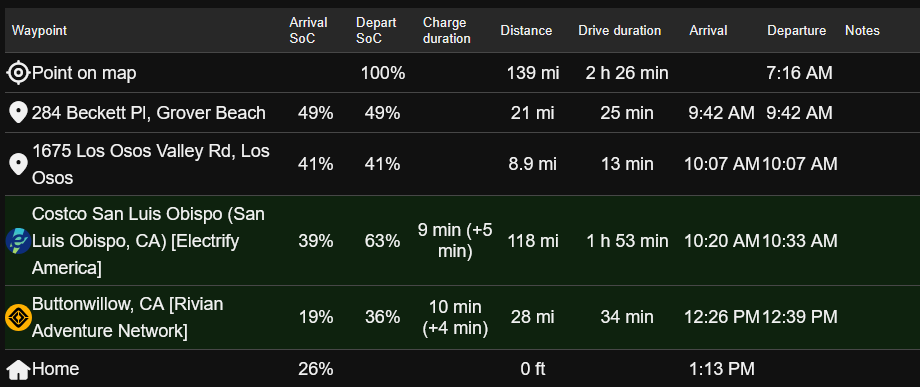
I still plan my road trips, but not to the extent I used to. These days, I don’t create a spreadsheet for each trip. (See 400 Mile EV Road Trip–without a Spreadsheet!.) Now I simply rely on ABRP (A Better RoutePlanner) to plan the drive and then I print out a table of the charging stops. However, I don’t just take the first plan ABRP gives me. I work with it to get the stops where I want, not necessarily where it wants me to stop.
Unfortunately, I knew this route well, having driven this route to the coast many times in an EV. Sure, we were adding on another stop a little further along, but all in all a typical drive to the coast. We would charge in Grover Beach as we had done many times before. So I added up what ABRP was telling me I’d need and I figured I should charge to a minimum of 75% and that should have got me home.
It would have. But for some mysterious reason the Rivian dispenser stopped at 73%. Oh well, we were already late for our next stop and 73% should be good enough, I thought. It wasn’t. I should have reviewed the ABRP table more carefully before we left for home—but I didn’t.
The last issue was ignoring what both ABRP and Google’s route planning were telling me. Both said we had ample charge to our destination. Or what I thought was our destination. It wasn’t. Both route planners were directing me to a charge station on Buttonwillow right off I-5. To my embarrassment, ABRP told me as much in their table.
So I was driving with full confidence until I passed the turn for Buttonwillow and its fast chargers. Both route planners were yelling at me to turn around. Did I listen? No, I knew better. We were only 20 miles from home—and its charger.
I have both planners set to arrive at my destination with a conservative charge remaining of 15%. That’s a pretty large cushion in the EV world and I’ve driven up the driveway with 8% a few times by ignoring the planner’s advice.
Not so this time.
That 2% missing DCFC charge at the Rivian station in Grover Beach would have saved us from going turtle. Stopping in Buttonwillow at either the Tesla or Rivian station would also have saved us from going turtle, though it would have taken a little longer and over a route I prefer not to drive.
My principal error? I didn’t “drive the plan.” I made the plan. I took the plan with me. But I didn’t follow it. I didn’t even review it until I got home—and charged the car.
The lesson: Plan the drive, and drive the plan.
