This will take some getting used to, this 2027 Chevy Bolt. Our “Marina Blue Metallic” Bolt was delivered 20 February 2026. After one week of ownership I am still adapting the car to my needs–and adapting myself to the new driving experience.
Nearly three years since GM killed the model, the Bolt is finally back. Based on the discontinued Bolt EUV, our new Bolt uses a Chinese LFP traction battery and a drive train from the popular Chevy Equinox. Though the name is the same, much has changed since we purchased our 2020 Bolt LT. (See The Bolt’s Gone–Long Live the Chevy Bolt.)
I’ll write more about our experience driving the new Bolt, but here are some specs on the car and some initial observations.
Size
The Bolt (it now has only one name) looks, feels, and is bigger. The wheelbase is three inches longer than the first generation Bolt. On top of that they’ve extended the hood, giving the car a more SUV look and about four inches of empty space behind the grill.
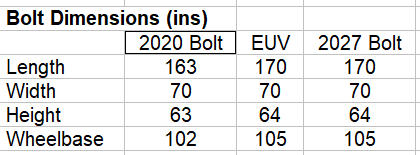
The car has the look and feel of an SUV, replacing the sloping hood of the original Bolt with a squared-off front fascia.
Interior space is much the same as before. Our Bolt floor mats fit the 2027 model with the exception of the rear seat floor mats, which have a gap of three inches because of the longer wheelbase.
Curb Weight
Despite its larger size, the new Bolt is only 200 pounds heavier than the first generation Bolt. That’s about the weight of one passenger.
Frunk
There isn’t one. The inverter, gearbox, and motor stack fills the engine bay as it did in the original Bolt. GM made no effort to move components around to provide a small frunk as in Hyundai’s EVs. Drivers of the original EUV have suggested adapting that empty space between the engine bay and the grill with a storage bin.
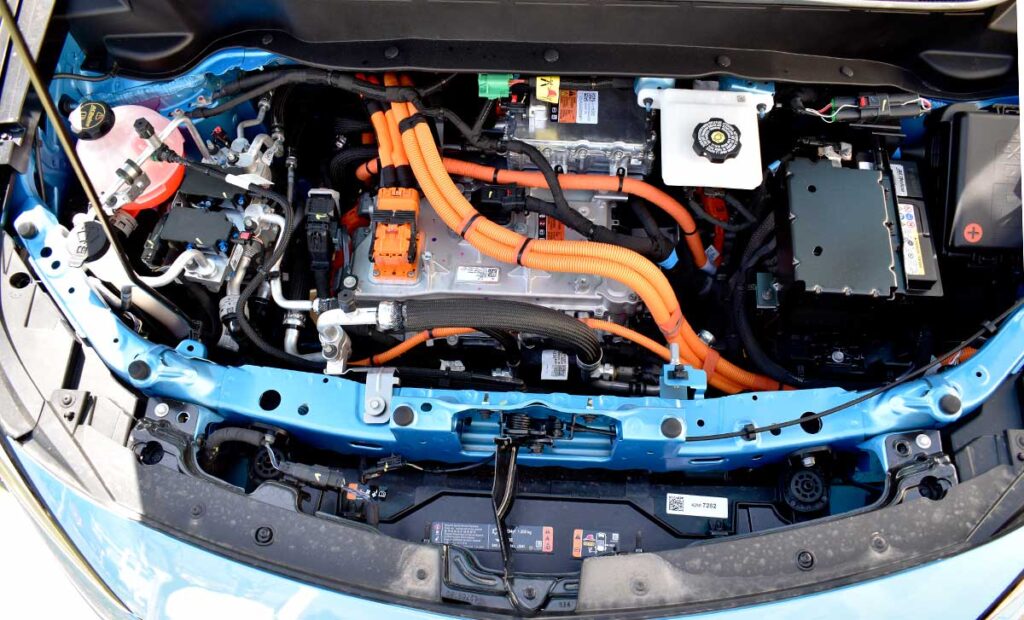
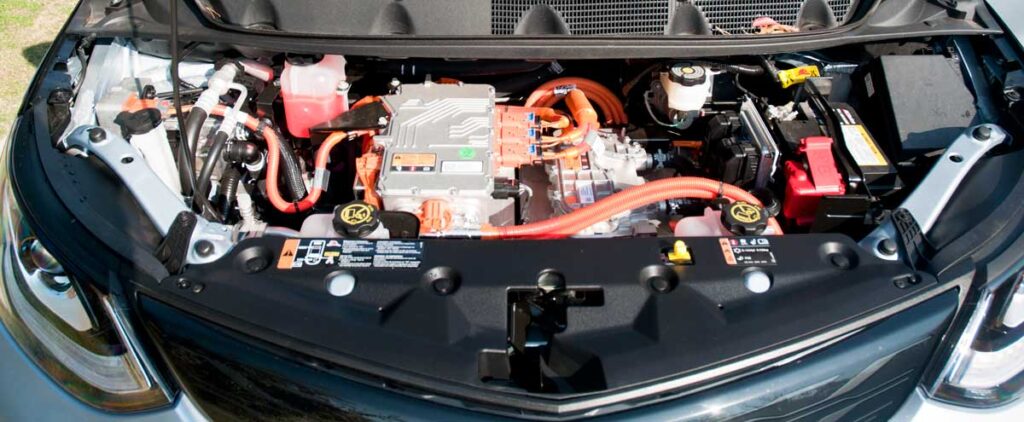
Engine bay on the 2027 Bolt (left) and first generation Bolt (right).
Front Doors
My wife, Nancy, noted immediately that the doors were bigger as they take a little more effort to open than in the original Bolt. In fact the doors on the new Bolt are two inches longer than on the old Bolt and taller as well. That’s a fair amount of more metal for the doors in the new Bolt and its noticeable when exiting the car.
Wheels & Tires
When I checked the trunk to be sure that the portable charge cable (now 240 volts), I noticed that GM included a can of tire sealant and pump kit. That’s noteworthy. The original Bolt came with Michelin self-sealing tires. The tires on the new Bolt are not self-sealing, so GM threw in the sealant kit.

While the wheels are the same size as before, GM switched tires to Michelin’s e.Primacy. Presumably, the new tires provide 20 miles more range due to less rolling resistance than comparable brands (~9% increase in range for Tesla’s Model 3), according to Michelin. (See Michelin e.Primacy All Season.) The tires also run at higher pressure, 41 psi, than the self-sealing tires at 38 psi.
Content
The lithium-iron-phosphate battery was made in China, accordingly, 51% of the content of the car is Chinese. U.S. & Canadian sources account for 17% of the new Bolts content. In contrast, 57% of our 2020 Bolt contained Korean content, and 24% was from the US & Canada.
Assembly
The 2027 Bolt was assembled by UAW Local 31 at the Fairfax assembly plant in Kansas City, Kansas. Our 2020 Bolt was assembled by UAW Local 5960 in Lake Orion, Michigan.
Range & Fuel Economy
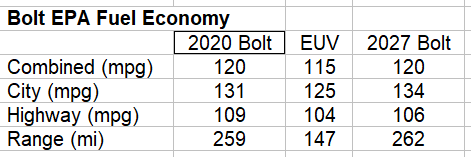
Both the EPA range and fuel economy of the 2027 Bolt is about the same as that as the original Bolt, though it does better than the original EUV.
Traction Battery Capacity
Again, the listed 2027’s traction battery capacity is about the same as before. However, the initial reading of the 2027 Bolt’s capacity with Car Scanner ELM OBD2 and my OBD dongle was 69.9 kWh. This software is new to me. I couldn’t get Torque Pro to connect to the car’s ECU, so this reading may or may not reflect the battery’s actual capacity.
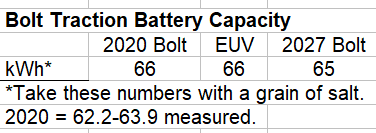
When GM replaced the battery in our 2020 Bolt three years ago, the new battery indicated 62.2 kWh in Torque Pro. My estimate of the 2020’s capacity based on the amount of energy used in the first few charges was 63.9 kWh.
My sense is to take all specs on battery capacity–as with range–with a grain of salt. It’s useful to monitor capacity to track degradation if any, but what’s more important is whether the car has the capacity and range to do what you want it to do.
Driver’s Information Center (DIC)
The driver’s information cluster or binacle now displays state-of-charge, both upon entering the vehicle and while the vehicle is “on.”
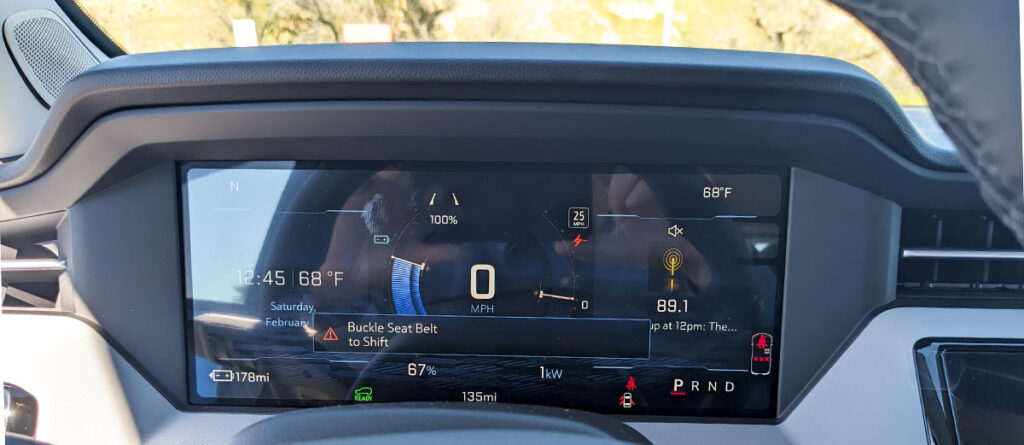
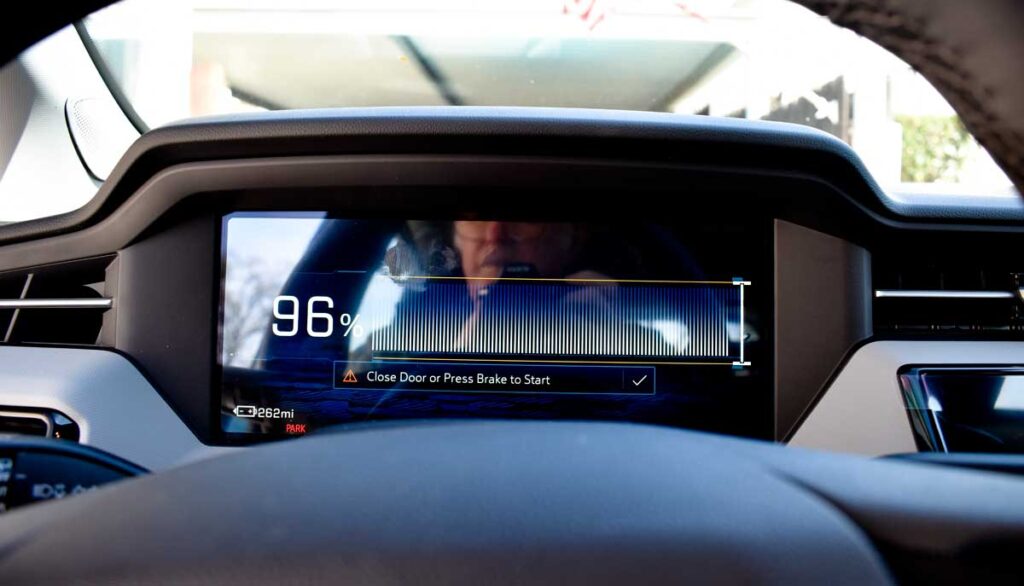
Driver’s information cluster now shows state-of-charge (SOC).
Center Console & Apps
As in the EUV the center console is a flush piano black screen in contrast to the screen in the original Bolt with a prominent plastic frame. The screen is much more responsive than in the original Bolt. And though you can’t use Android Auto or Car Play, the installed apps will be familiar to anyone coming from an Android phone.
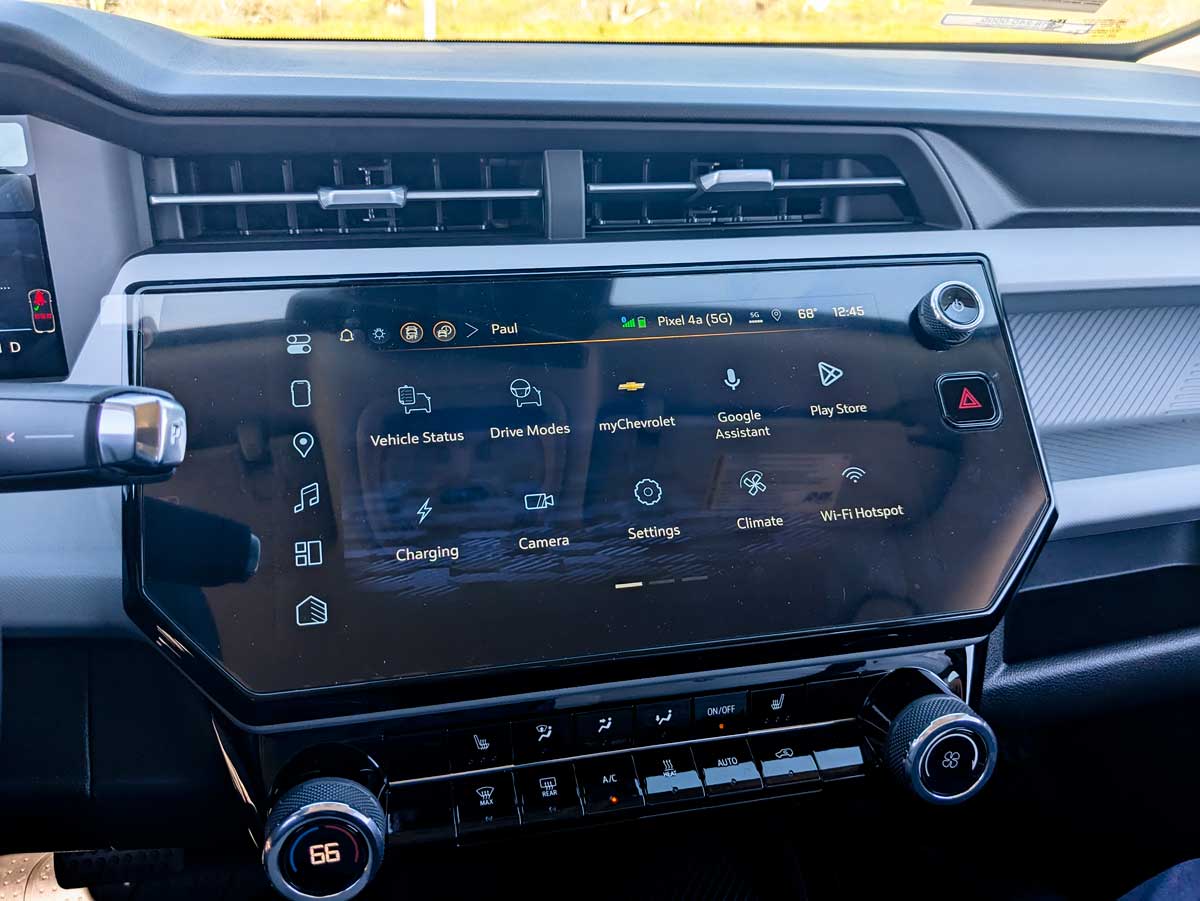
I was concerned that Google’s Android Automotive operating system wouldn’t permit A Better Route Planner. I needn’t have worried. I simply downloaded it from the Google Play Store. (It appeared so quickly that it may have been pre-installed.)
The icons can be moved around the screen just as on an Android phone. I pressed and held the ABRP icon and moved it to the top of the home screen. From there I was able to add it to the default apps that are always present just to the left of the main screen. (You can only have six default icons. I gave up Spotify, since I don’t use it.)
Now I have quick access to both Google route planning and ABRP, allowing me to quickly switch between the two.
Handling
The new Bolt doesn’t feel as nimble as the old Bolt. It may be similar to the old EUV. I don’t know. The car is bigger and feels bigger and it will take some time to know intuitively where the edges of the car are on the road and in a parking lot.
Visibility
The new Bolt has significant blind spots to the front. The “A” pillars are thicker on 2027 Bolt versus the old Bolt, which also had a small window between the two struts of the “A” pillar. The blind spots became apparent on the second day of ownership when I started to pull out into a cross street until a truck crossed from behind the blind spot. I saw it in time and now I know to move my head to peer around the pillars to see if I am missing something.
Seats
The seats are fine to me. I didn’t have any problems with the seats in the old Bolt. For now, Nancy’s not pleased with the passenger seat in the new car. We’ll see how she feels after a few months.
Interior Color
We liked the two-tone interior color scheme of our 2020 Oasis Blue Bolt. The interior of our new Bolt is jet black with blue & gray accents. It’s acceptable and certainly preferable to all black.
Parasitic Losses or SOC Drift
I’ve noted that every day when I go out to the car, it’s lost one percent state-of-charge (SOC) since the previous day. I don’t know if this due to parasitic losses or if there’s simply drift in how the car records SOC.
GM emphasizes charging the car to 100% weekly so that the car knows how much capacity it has, suggesting that there may be drift in the SOC or range estimates.
On-Off, Start-Stop
Early reviewers have noted that the new Bolt doesn’t have a traditional “Start-Stop” switch. Instead, the car comes alive as you approach it with the key fob. To turn the car “on” after you enter the car, you press the brake pedal. It also switches off after you leave the car. However, there is an “off” switch on the center console touch screen, which requires two steps. First you press an icon, and then you answer a question whether you want to turn the car off or not.
Because we park the new Bolt in the driveway near our kitchen, the car comes alive and turns on the headlights whenever I walk into the kitchen. This is annoying—to say the least. Maybe there’s a command to alter this behavior, or maybe there will be one in some “over-the-air” update in the future. I certainly hope so. 😉
