We recently drove our 2027 Chevy Bolt—the “new” Bolt—1,520 miles to Grants Pass, Oregon and environs from Bakersfield, California to see friends and to botanize.
While some of the trip was on two-lane highways and some was off paved roads, most of the trip was on Hwy 99 and I-5. We didn’t hypermile or otherwise try to limit consumption. We drove with traffic, which for anyone who has driven these roads, is well above the speed limit.
Chevy’s new app keeps a history of charge stops, including peak power, average power, and kWh delivered to the battery. (See 2027 Chevy Bolt Peak Charging Rate.) This makes tracking energy consumption much easier than in the past.
We consumed 417 kWh for the trip, giving an overall average efficiency of 3.6 miles per kWh. My record keeping on previous trips on this route are incomplete. One leg of one trip in our 2020 Bolt (not an EUV) gave us 3.6 miles per kWh. The efficiency of the new Bolt is comparable to the original Bolt.
With a 70 kWh traction battery, the new Bolt with an average efficiency of 3.6 miles per kWh delivers a range of nearly 250 miles at highway speeds.
Cost Comparison with a Gasser
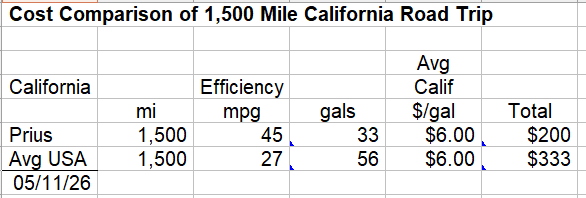
I didn’t keep tabs of the cost of each charge stop. Assuming that each kWh from a DC fast charge station was at least $0.50/kWh, the 430 kWh we used on this trip cost about $215. That’s comparable to a Prius driving the same route and paying the average cost of gasoline in California of $6.00/gal. Using the average fuel economy in the USA, it would have cost about a third more than the EV.