As in our previous trip to the Southern Sierra Nevada and return to Bakersfield, the 2027 Chevy Bolt matched the efficiency of the first generation Bolt on another trip to the mountains. (See 2027 Chevy Bolt Bakersfield to Bald Mountain Efficiency Bests 2017 Bolt.)
On the 17 July we drove our new Bolt to the National Forest Service’s Horse Meadow campground in the Sequoia National Forest. The 177 mile round trip was on sinuous mountain roads at speeds often less than 40 mph. A portion of the trip was on unpaved Forest Service roads where speeds were often less than 15 mph.
I mention the average speeds here and in the previous article because at low speeds there’s very little aerodynamic drag. The frontal profile of the 2027 Bolt is blunter than the first generation Bolt and may have higher aerodynamic losses than the original Bolt. Mountain driving negates any aerodynamic differences between the two models.
We’ve visited the campground several times in the past on botanical explorations of the Kern Plateau. On two trips to Horse Meadow using the first generation Bolt, the car consumed an average of 40.3 kWh for an efficiency of 4.4 mi/kWh.
ABRP (A Better Routeplanner) estimated we’d arrive at the campground with 57% state-of-charge and return home with 40%. We arrived with 56% and got home with 42% state-of-charge.
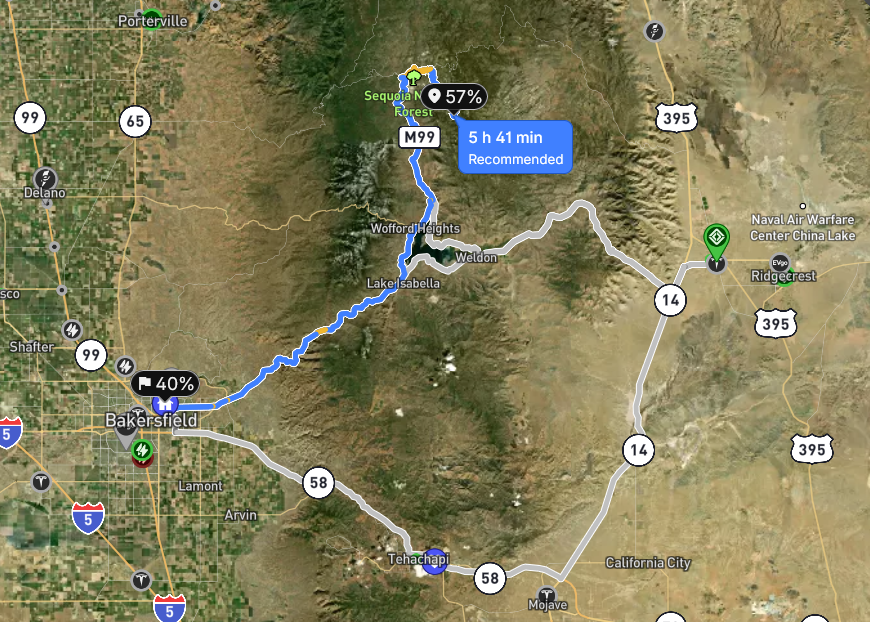
On the current trip the 2027 Chevy Bolt used 40.8 kWh for an efficiency of 4.3 mi/kWh.[1]
Summary of 2027 Bolt Mountain Trips
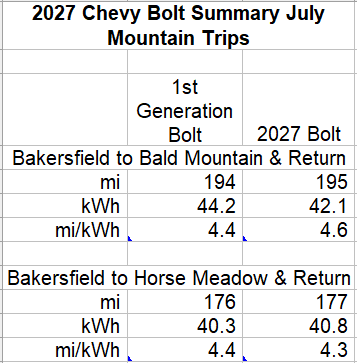
The difference between the two Bolt models is within the margin of error for such a comparison.
[1] The 2027 Bolt does not report kWh used directly, unlike the first generation Bolt. The 2027 Bolt reports kWh remaining from a battery with 70 total kWh using Car Scanner ELM OBD2.
