One month after receiving delivery of our 2027 Chevy Bolt at the end of February, I filed a comment with GM’s EV concierge about an odd noise when driving our new car. (See 2027 Chevy Bolt Odd Noise at Low Power Levels.) There began a series of communications with GM’s engineers via the concierge assigned my case.
While researching the problem I found that I wasn’t alone with this issue. GM had issued #PIC6650 on 31 March describing a moan or hum at 75-80 mph. The odd noise wasn’t limited to high speeds. I recorded and edited two sound files while driving the car on an arterial near our house and sent them to GM. That must have piqued their curiosity because they asked me to send them again.
Subsequently, the concierge asked me to take the car in to our local Chevy dealer. A technician drove the car, confirmed my complaint, and noted that GM was aware of the issue.
In early May the concierge asked me to take the car in to the Chevy dealer again at the request of GM engineering. They finally released the car back to me after 15 days. Neither the concierge nor the service adviser could tell me what they were doing with the car or how much of that time GM was actively trying to troubleshoot the problem. All they could tell me was that GM was “sending an engineer” to look at the car. Where that engineer came from and how much time was spent in travel and actual analysis of the problem remains a mystery.
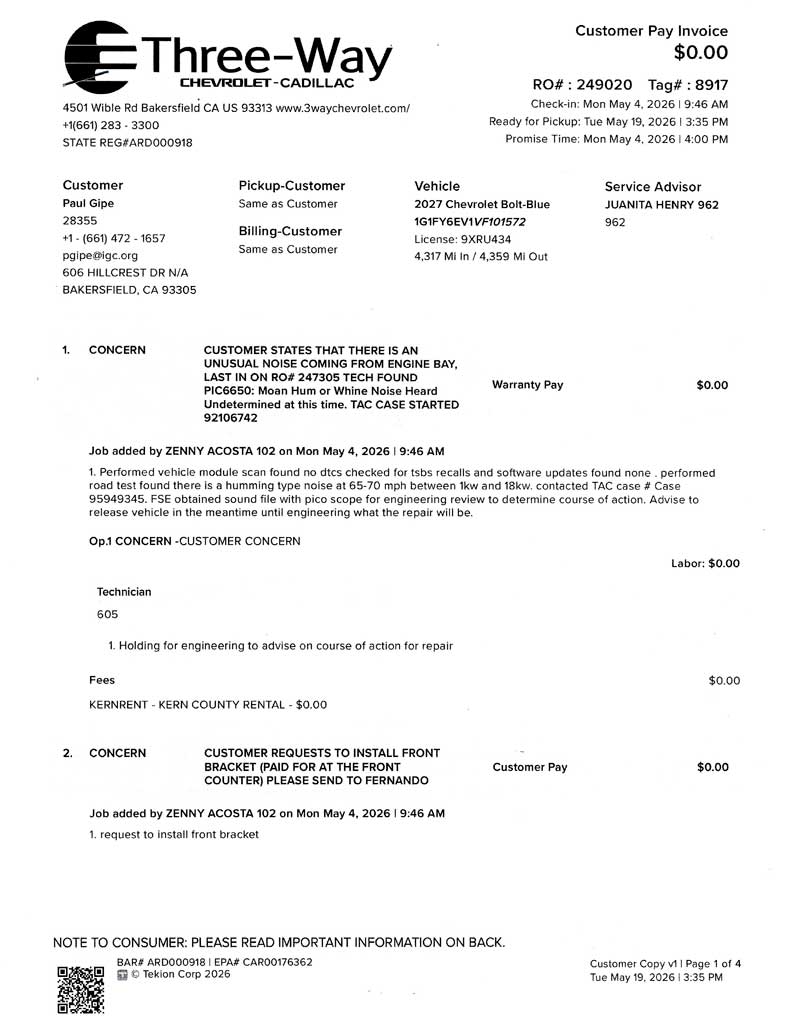
The service adviser issued an invoice for $0 with a description of my complaint and the action taken. No trouble codes were detected, there were no recalls, and all software was up to date. An FSE (I assume this means Field Service Engineer) confirmed the problem on Case 95949345 and recorded a sound file with a PicoScope for engineering review.
That device was new to me. I haven’t worked for GM since the late 60s so I have no idea what diagnostic tools they use these days. It turns out that PicoScope is a trade name for a digital oscilloscope that feeds data to a laptop computer. Here’s how they describe their product.
“PicoScope is a powerful automotive diagnostic tool that gives you detailed insights into your vehicle’s systems. It’s user-friendly, with advanced features like waveform comparison, easy data sharing, and non-invasive testing, ensuring you can diagnose issues accurately and efficiently. Whether you’re a seasoned technician or just starting out, PicoScope helps you get to the root of problems faster and more reliably than ever before.”
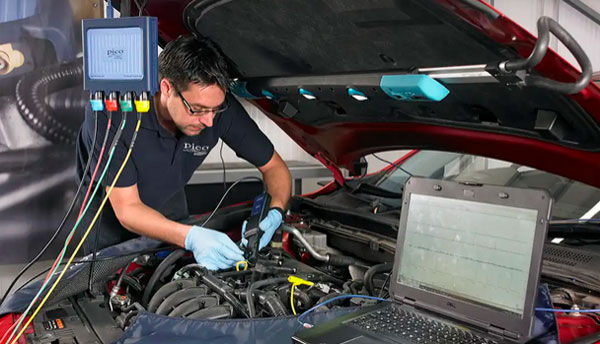
The company posts case studies of how the device is used in the automotive sector. Two of those case studies involved EVs. PicoScope has been used to troubleshoot a Tesla Roadster | ABS and TC warning lights and a Renault Zoe | Renault Zoe HVAC. The latter they note is critical for cooling the traction battery.
GM hasn’t said what is causing the Bolt’s noise problem or what the fix might be. I expect to hear back from GM when to take the car in again. I hope they don’t keep the car as long the next time and simply fix the problem. If they keep the car for another two weeks they will be bumping up against the 30 day window here in California.
My series on the 2027 Chevy Bolt.
- 2027 Chevy Bolt Odd Noise at Low Power Levels
- Pumping Gas—My My Times Have Changed
- 2027 Chevy Bolt 1,500 Mile Road Trip Efficiency
- Edmunds Confirms 2027 Bolt Has More Range than Advertised
- 2027 Chevy Bolt Google Route Planning Experience
- 2027 Chevy Bolt Peak Charging Rate
- 2027 Chevy Bolt Range is Holding Steady at ~280 Miles
- One-Month 2027 Chevy Bolt EV Update: Range & Capacity
- Finding kWh Consumed on 2027 Chevy Bolt EV
- 2027 Chevy Bolt Owner Initial Impressions
