Electrification: Tracking Down a Mystery Outlet
We have a mystery outlet in the kitchen. It’s an old style outlet and clearly designed for 240 volts.[1]
It’s not you standard 120 volt duplex outlet and its location near the gas stove leads one to conclude it must have been used for an electric range. If we could just plug our new induction range into this outlet, we could save ourselves—and our contractor—a lot of work.
But it’s not “hot.” It’s inactive. The mystery, then, is from whence does it come and where does this circuit go?
We’ve had two major upgrades of the load or distribution center since we’ve lived here and the question never came up. Why would it? We’ve always used a gas stove. But it’s now an issue since we are eliminating fossil gas in the house.
This is another in a series of articles about us “electrifying” our house so we can stop burning stuff.
If this mystery circuit (the wires in it) goes across the underside of the house to anywhere near the current load center, we can just rewire the ends to a new outlet in the kitchen and a new circuit breaker in the load center cabinet.
Down into the Darkness
No one wants to crawl under a house. It’s certainly not my idea of a good time. I haven’t done it in years, decades even. That’s why we hire contractors with younger more nimble employees. They do the dirty work.

But I was curious about the mystery circuit and I wanted to get this project moving. So down into the darkness I went.
First, I suited up. I squeezed into my old Danish coveralls (seem a lot tighter than before), put on my bicycling skull cap, and laced up my boots. Grabbed a point & shoot camera and one of those fancy modern LED trouble lights, put on a face mask, and pulled on my gloves.
Then I pushed aside the cobwebs and squirmed head first into the crawl space. The powerful trouble light was much easier to use down there than a handheld flashlight or even a headlamp. It really lit up the space. This was a lesson I learned from watching the young men installing our solar system a few years ago as they moved around inside our attic.
I’d already done an hour of yoga so I was as flexible as I was going to get. I crawled on my stomach through the first room and then through the narrow passage in the old foundation wall into the next space. This isn’t for the claustrophobic.
Now I could see the plastic conduit for the EV charge station our electrician installed a decade ago. I could see where it entered the crawl space. That’s where the current load panel is located. Then I saw a long piece of ¾-inch flexible metallic conduit snaking its way under the house toward where the old load panel had been.
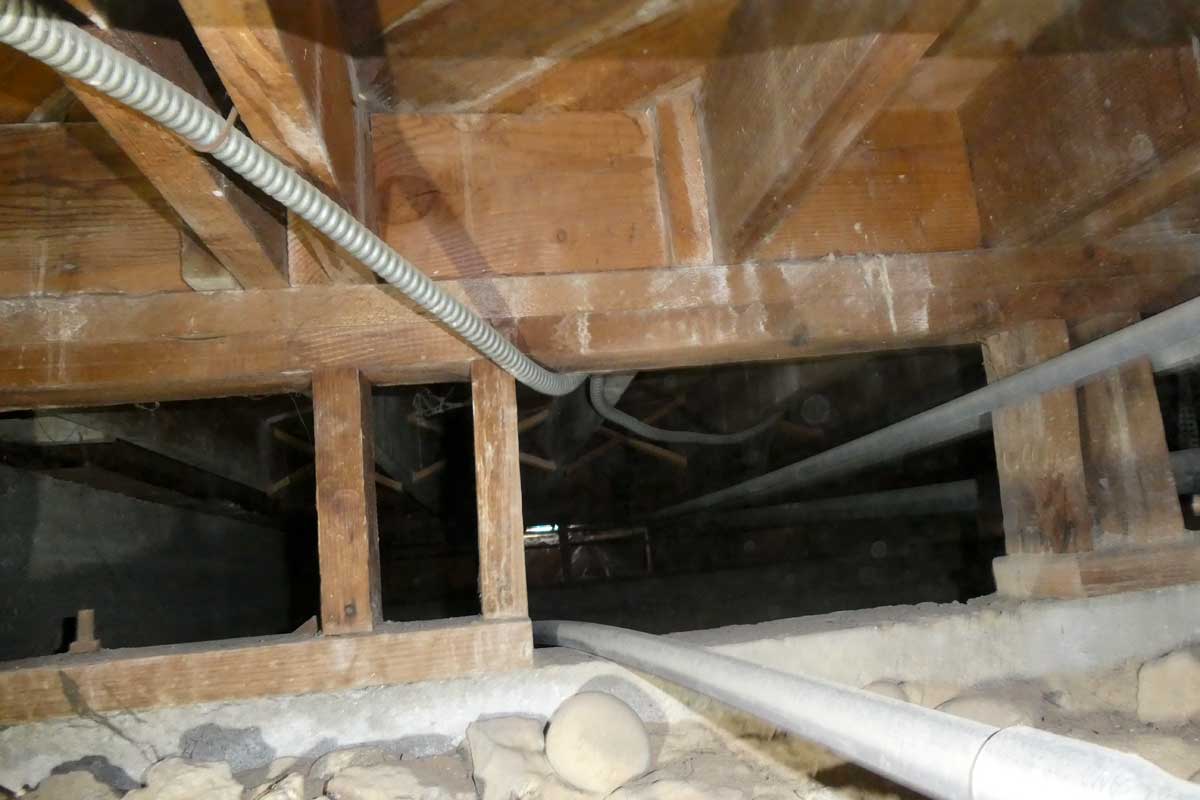
Aha! That’s what I was looking for—the mystery circuit. It led off in the darkness in the direction of the kitchen through another hole in the foundation. I crawled over to the edge of the space and weighed my options—and my courage.
Since the last time I’d been down there, we’d added a sewer line to a new bathroom, and the conduit for the charge station. There were also gas lines and water pipes to contend with. It was an obstacle course and once through that narrow opening it was still a long way to the kitchen. That’s when my ambition ran out. I crawled as close as I could easily get to the opening, stuck the light through and took some pictures. The metallic conduit clearly snaked through the floor joists towards the kitchen. It was large enough to hold the three big conductors needed for a high current circuit.[2]
That’s all I needed to know. I took some more pictures and began the laborious process of turning around for the journey out to daylight. Crawling over the break in the foundation was just as uncomfortable as going in, but at least I could see the entrance ahead. The final bit getting out head first was challenging, requiring upper body strength only as I dragged my feet out of the opening.
I called to Nancy and she came out with a broom to brush me off—from head to toe. Then I stripped and dumped my clothes in the washing machine. I checked myself over. Still had all my pieces, no bruises, no cuts, no blood. The face mask was shot. It had dust on both the outer and inner surfaces. Good thing I wore it.
And that was it. Probably the last time I go down there.
All for Naught
The effort was for naught. The conduit was old BX cable or “metallic sheathed cable.” You see it in old homes like ours. Electricians don’t use it much anymore. In our case it was probably installed shortly after the house was built—seventy years ago–and the insulation on the cables may have deteriorated over time. It would be safer to install a new circuit with the appropriately rated cable than to use the old BX conduit.
Further, 240-volt circuits today use four wires. The old receptacle used only three wires: two hots and one neutral.
So we hired a licensed electrician to add a 40-amp circuit and install a NEMA 14-50 receptacle in the kitchen for $1,000. This is the same size circuit we have for charging our EV.
Poor Communications
Of course I told the contractor what I wanted when he bid the job. I assumed—wrongly as it turned out—he would have explained this to the electrician.
Romex brand non-metallic sheathed cable seems to be more popular these days than when I was an apprentice electrician decades ago. That should have made the job quick and easy.
The electrician dutifully ran the Romex cable from the service panel to the outlet. Then he removed the old outlet. I told him he needed a NEMA 14-50 R (receptacle) for the induction range. He looked at me quizzically and that should have been a tip off. He went to one of the big box stores for the receptacle and returned with the announcement that the receptacle required four wires and he only ran three.
So back under the house he went and pulled in new Romex of a different color. He was good natured about it and didn’t grumble at all. He wired up the receptacle and called it a day.
Later I looked at the circuit breaker he’d installed. It was only 30 amps not the 40 amps the stove required.
So he had to come back for a third try. He had to run new cable to safely power a 40-amp circuit and install a 40-amp circuit breaker.
The lesson in all this is for the homeowner (me) is to not only clearly explain to the contractor what is needed, but also explain to the people actually doing the work. If I’d done this the poor electrician wouldn’t have had made three trips under the house.
Of course the real test will be when we plug in the new stove.
Electrification Series
- Steps to Electrification: Dumping Fossil Fuels
- Electrification: Tracking Down a Mystery Outlet
- Electrification: Fossil Gas is Gone–PG&E Pulled the Meter
- Electrification: Induction Stove
- Electrification: Heat Pump Water Heater
- Electrification: Heat Pump Dryer
- Electrification: Heat Pump Home Heating
- Electrification: Is Complete–We No Longer Burn Stuff
[1] It’s an old NEMA 10-30R.
[2] Actually, today’s 240-V circuits require four wires: two hots, neutral, and a ground.
