My historical journey into the deep recesses of wind energy took another odd twist yesterday. I was updating my bibliographic … Read more
My historical journey into the deep recesses of wind energy took another odd twist yesterday. I was updating my bibliographic … Read more

During the heyday of the Great California Wind Rush in the early to mid 1980s, there were a handful of … Read more

Tehachapi Windmill-Wildflower Hike 2024 38th hike Paul Gipe and Georgette Theotig will lead a hike among the wind turbines on … Read more
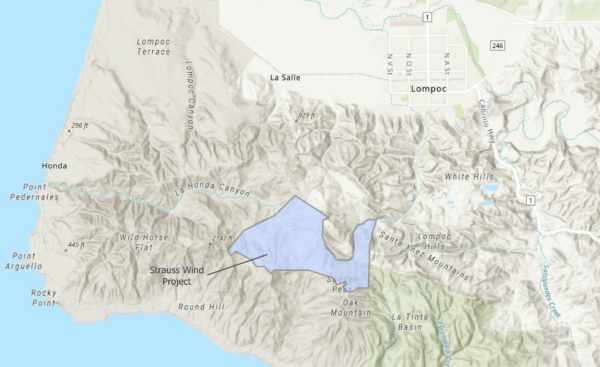
The Strauss Wind Project in Santa Barbara County, the first wind farm on California’s coast, is now online.
The 98-megawatt (MW) Strauss Wind is near Lompoc, on the Central Coast, with Vandenberg Space Force Base to the south, west, and northwest. The location’s 3,000-acre topography is perpendicular to the predominant wind direction from the ocean, making it an ideal location to generate wind power.

It’s also why journalists should avoid treating bird deaths at wind farms as unforgivable sins, rather than as nasty side effects of renewable energy development that we should work hard to minimize but likely can’t avoid entirely.
As part of his study, Katovich used the International Newsstream database to run a comparison. He found that in 2020, major U.S. news outlets published 173 stories about the effects of wind farms on birds — and just 46 stories on fracking impacts.
I wrote last week that it’s time to see the world through climate-colored goggles. That’s true for the media as much as anyone.

Today, the country has almost phased out fossil fuels in electricity production. Depending on the weather, anything between 90% and 95% of its power comes from renewables. In some years, that number has crept as high as 98%. Uruguay, meanwhile, has moved on to what is becoming known as the second stage of its transition. It is gradually moving its buses and public vehicles over to electric, and incentivising taxi and minicab drivers to switch.

New Berkeley Lab study of half a million transactions across the country finds evidence of temporary decreases in home sale prices in more populous counties within 1 mile of wind projects, starting after the project’s announcement but returning to pre-announcement inflation-adjusted levels 3–5 years after operation begins.

I’ve written extensively about the misuse of wind turbine power ratings and why the term “capacity factor” should not be used.[1] In short, don’t use it. There are much better descriptors of wind turbine performance.
Many of the outlandish claims by inventors rely on the improper use of power ratings and capacity factor. It’s easy for unscrupulous promoters to hoodwink the public, the media, and even some engineers with the sleight of hand that “power ratings” and “capacity factors” makes possible.

In recent correspondence with colleagues, I noted the unfortunate reoccurrence of the term “wind parks” to describe wind farms or … Read more

Reflecting the concept’s newness are the many terms that arose to describe it: wind farms, wind parks, and wind power plants, to name a few. Early on, finding the best nomenclature created a dilemma. On the one hand, advocates wanted a term connoting wind’s technological success and its coming of age as a conventional source of electricity, conveyed by the term wind power plant. On the other hand, proponents also wanted to preserve the association with the enlightened land use–the stewardship–that the term wind farm implies.

2023 © Wind-Works by Paul Gipe