Our friend Sarah in Los Angeles asked what we knew about plug-in solar. We have solar, have had for several years, and I work with renewable energy so it was a fair question. I knew that “balcony solar” was big in Germany, but that was about it.
Solar was pretty much dead in California since Governor Newsom’s PUC put the kibosh on new residential solar in the state. Apparently, there was a lot of talk in the press about bypassing the PUC, the utilities, and permitting agencies by simply plugging small solar systems into the nearest outlet. “Whoa,” I thought, sounds like the 2020s version of what was once called “guerilla solar.” And down the rabbit hole I went.
Turns out, I was late to the party. The Solar Rights Alliance was leading the charge to legalize plug-in solar in California with a bill in the state assembly. And Bright Saver, an Oakland, California non-profit, was aggressively promoting the concept on social media.
So I turned to two old hands in the solar business to see what they knew. Both Steve Smiley and Mike Nelson knew a lot and were busy experimenting with plug-in solar themselves. Smiley had been a solar developer in Michigan and was an all-around renewables advocate. Nelson too had been around the horn a few times in the solar business in policy, industry, and education.
I was skeptical of the idea working here. We’re simply not as practical as the Germans, and we’re far more bureaucratic. Nelson and Smiley convinced me otherwise. It was happening here and it was just a matter of time before it would become legitimate.
Bright Saver
After looking into the background of Bright Saver, I found that it was being run by an Austrian, Rupert Mayer, who was trying to bring the Germanic concept of balcony solar to the Americas.
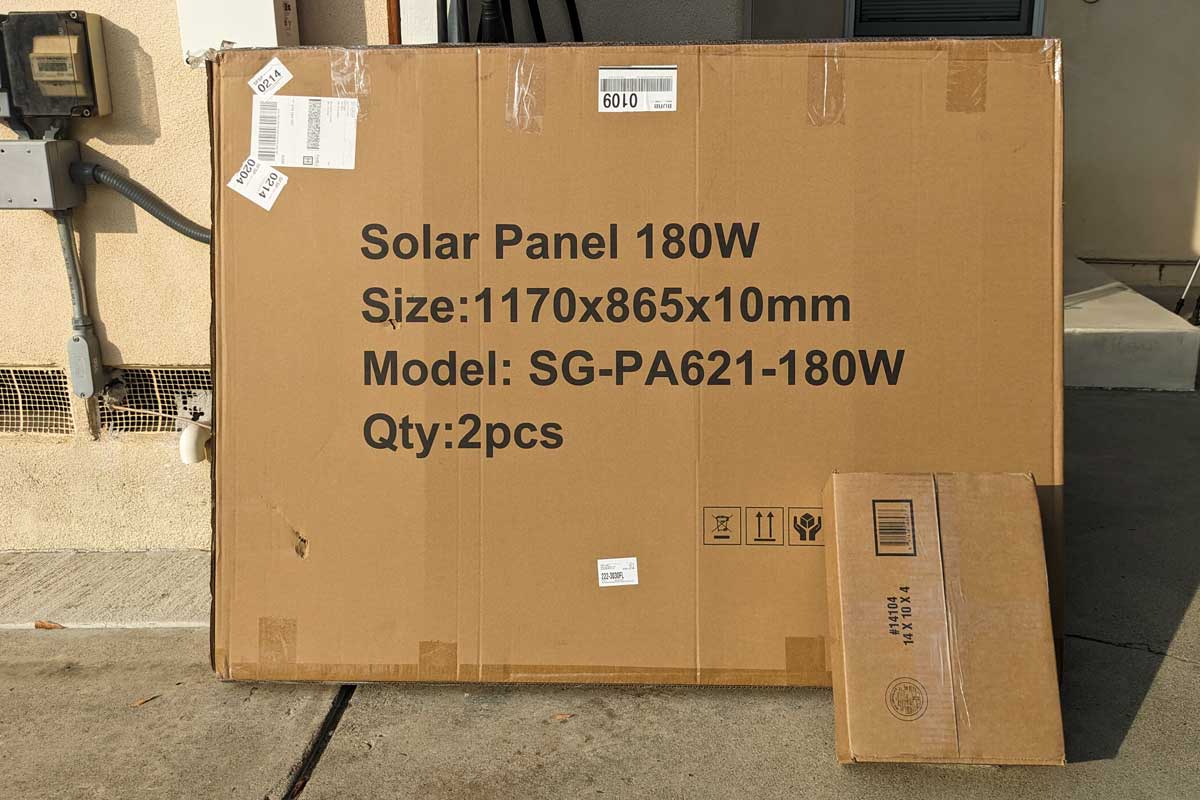
Interestingly, Bright Saver was offering a kit of two panels that could be shipped by UPS or Fedex. That was appealing. Normal size panels are quite large, requiring shipping by freight. Our Canadian-made panels by Silfab weighed 44 lbs each and were 6 feet long by 3.3 feet wide capable of generating 360 watts (W). Bright Saver’s panels were half that, enabling handling by homeowners and do-it-yourselfers–the intended market for plug-in solar.
We Need More Juice
Our solar system was sized for our energy efficient house and our EV. In the years since the solar installation we’ve fully electrified, removing the fossil gas line entirely. (See Electrification: Is Complete–We No Longer Burn Stuff for how we did it.) We were consuming about 6,000 kWh annually, but now we consume an additional 2,000 kWh to heat our home and hot water. For the Bakersfield climate–we live in a desert–that’s equivalent to four solar panels generating about 500 kWh each per year. Thus, we were in the market for more solar.
Prepping for Solar
Before I jumped on the plug-in solar bandwagon, I wanted to see what local solar installers could do first. I asked our electrician for a bid on 2,000 kWh of solar. They came out, climbed on the roof, took some pictures, and drove off. I never heard back. I called them a few times to remind them I expected a bid. Nada. Zip. My sense is that the job was just too small for them to bother. They make their money installing HVAC here where it’s not unusual for summer temperatures to reach 110 F (44 C). Solar is a sideline.
Instead of installing solar, I hired the electrician to install two new dedicated circuits on the outside of the house that they are gladly willing to do.
Dedicated Circuits
While the principle of plug-in solar is simple–you just plug the inverter into the nearest electrical outlet–its execution is anything but simple. Electricity can be deadly or start a fire. Consequently, there are rules, regulations, and codes around how to use electricity safely. The safest way to use plug-in solar is with a circuit that’s dedicated for that use on the exterior of the house. There are no conflicts then between the solar input and any appliances downstream that may also be on that circuit. And because it’s on the exterior of the building, it must also use a Ground Fault Circuit Interrupter (GFCI) outlet like those in bathrooms.
We have an exterior outlet that was installed 25 years ago. It has a GFCI. However, it’s not a dedicated circuit. So that was out.
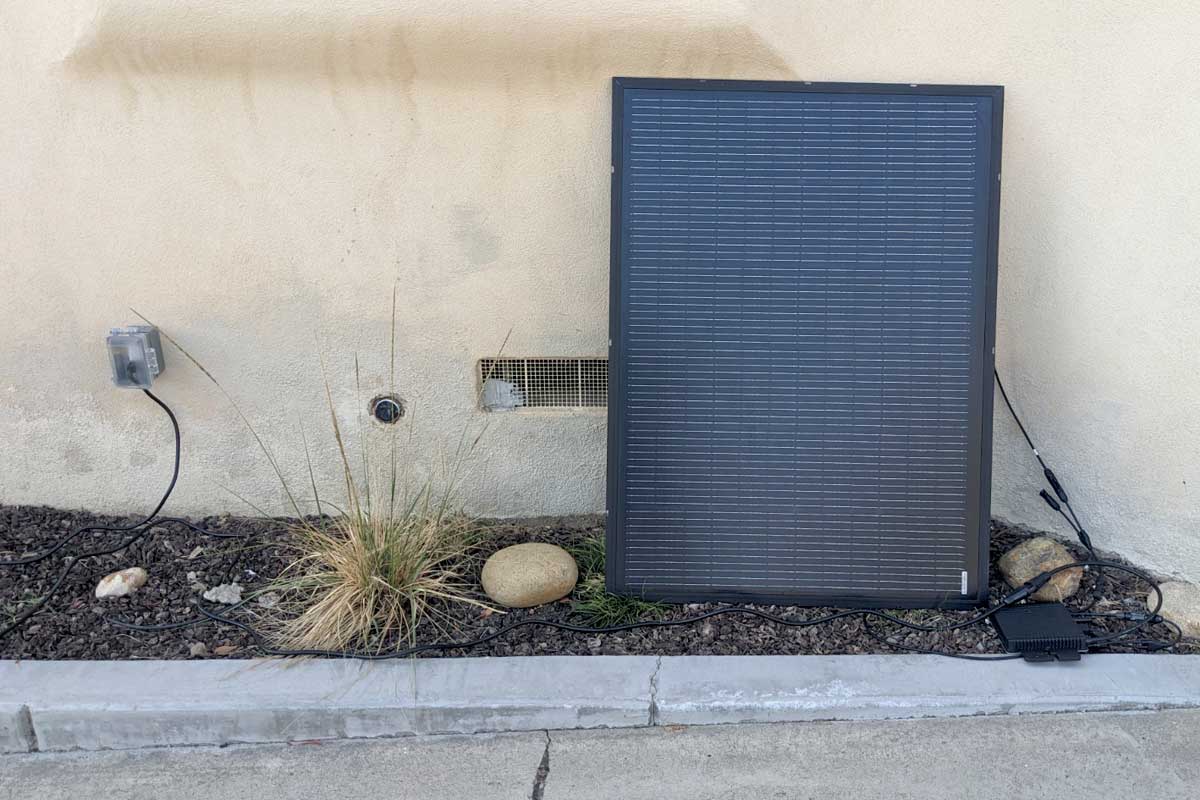
Our electrician then installed two dedicated circuits on the east and west walls of our house for $1,000. Ok, not cheap, but done to code.
Each circuit is tied directly into the service panel. These circuits would allow me to play with plug-in solar to see how well it worked.
Plug-in Solar Kit
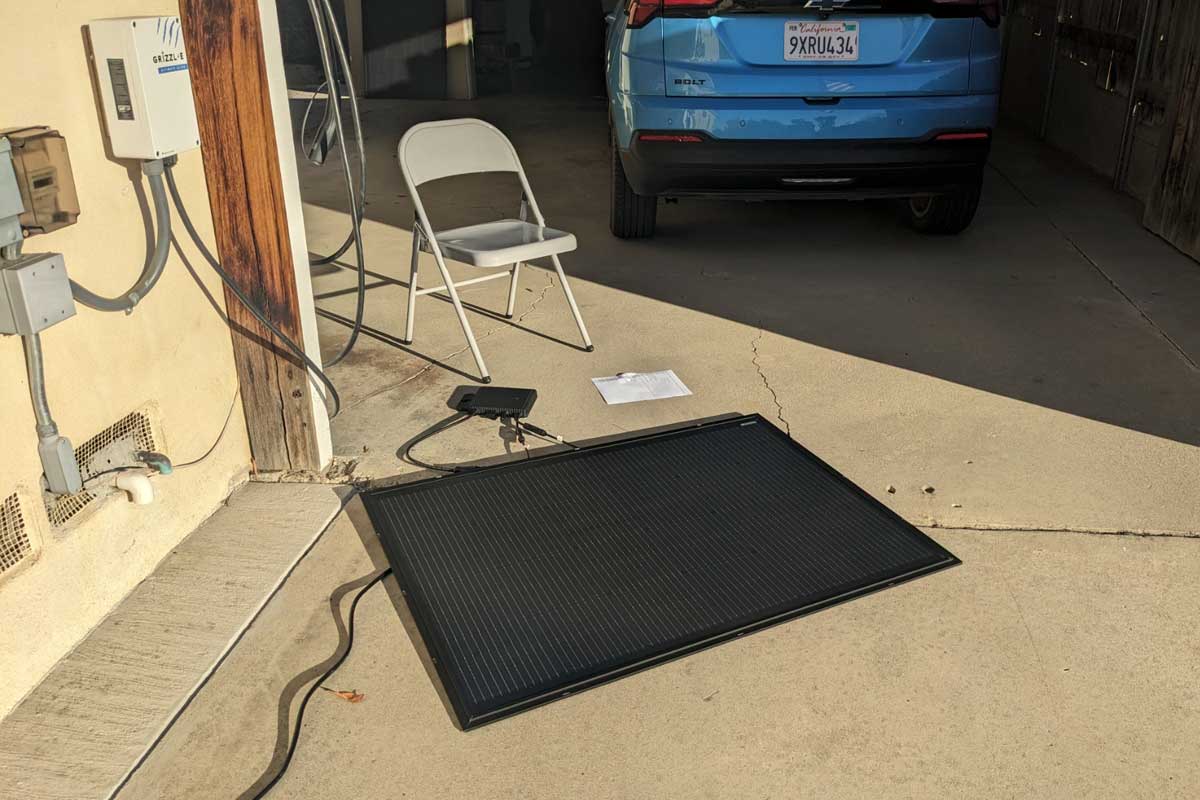
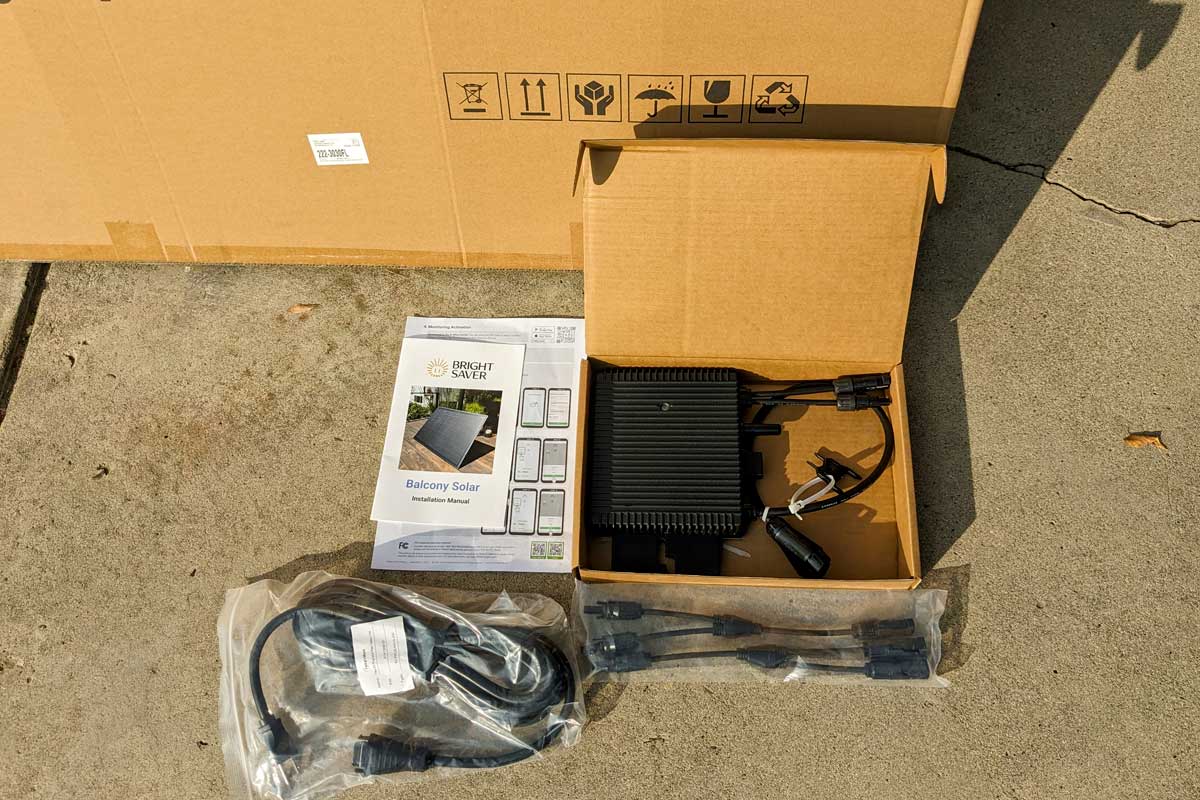
Bright Saver’s kit contains two 180 W frameless panels, an inverter, and metal cable ties. The inverter connects to the two panels for 360 W, equivalent to one of our existing Silfab panels on the roof. The inverter includes a 15-foot heavy duty cord with a NEMA 5-15 plug on one end for plugging into a conventional North American outlet.
Testing
While I’ve always warned against “fire-em-up-itis” when it comes to small wind, plug-in solar’s appeal is its simplicity and ease of installation. I couldn’t wait, I unboxed everything, plugged in one panel, plugged the inverter to the new wall outlet and Kazam! I was producing a few watts immediately. It took much longer to work through connecting the inverter to our wireless network than it did to start producing solar electricity.
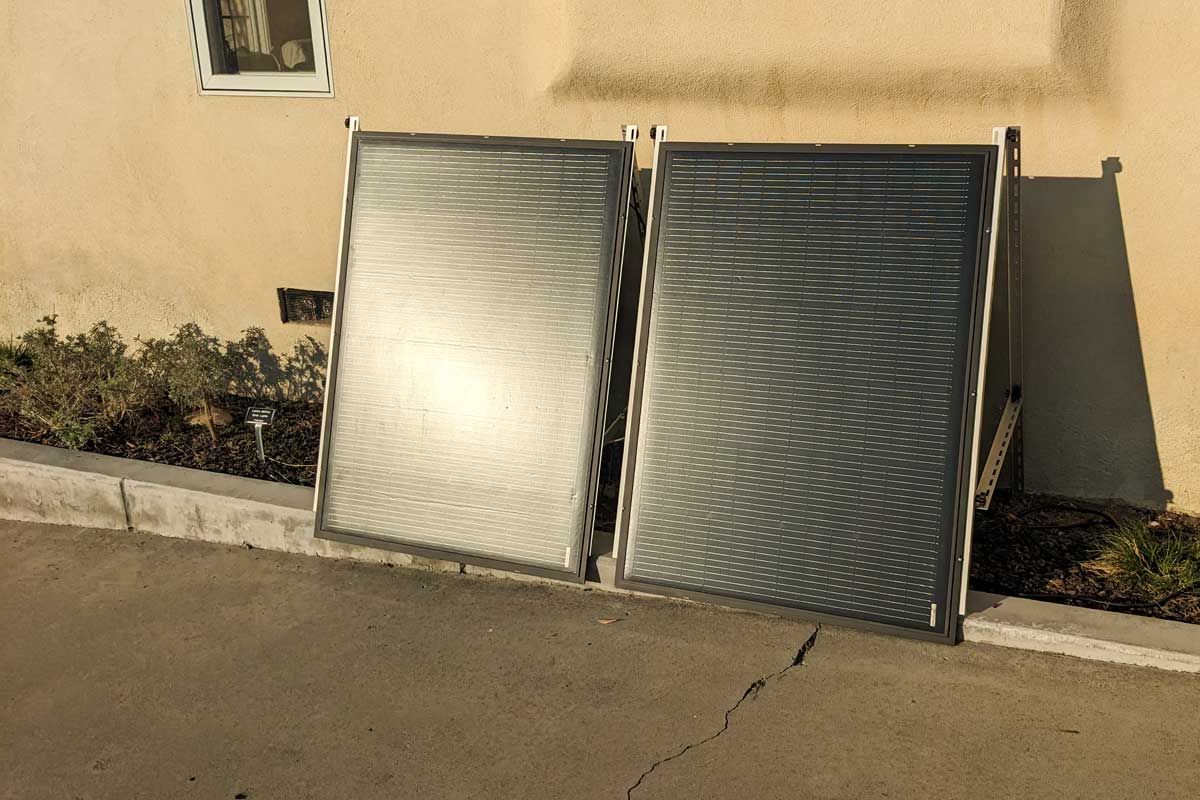
I next attached the frameless panels to a simple aluminum rack ordered separately, connected both panels, pointed them more directly to the morning sun and pushed the power up dramatically. Shouldn’t be a surprise, but it does work.
Newsom Signs California Plug-in Solar Law
In the meantime, the Solar Rights Alliance and others were successful moving the plug-in solar bill through the California legislature in record time, and placing it on the governor’s desk. Though I had my doubts that utility company friendly Gavin Newsom would sign the bill, he did, and it goes into effect in early 2027.
The bill requires that California plug-in solar use only UL-listed equipment, which at the time were not available. The requirements for UL listing were only being finalized, especially that for a unique plug that would protect inexperienced homeowners from the unprotected blades on the standard NEMA 5-15 plug that we use in the Americas.
Bright Saver gave me the option of waiting several months for the new UL-listed kit. I opted not to wait. My kit is not UL listed, but I am fine with the negligible risk of the existing plug with the exposed blades. We’ve been using these plugs for years with minimal risk.
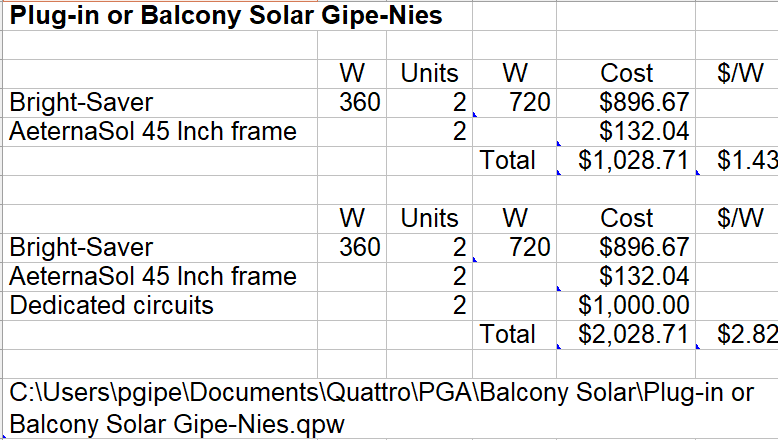
I’ll be writing more about our experience with the Bright Saver kits. We bought two for a total of $1,000 with frames or about $1.50/W. Including the electrical work, the total came to $2,000 or about $3.00/W. The latter is comparable to our existing solar system 4.3 kW system we installed for a little less than $3.00/W in late 2021. Of course that included installation. I’ll have to install these panels myself.
