Alexander Jacob reports in an annual analysis of Germany’s burgeoning balcony solar market that the total number of systems registered has topped 1.5 million. Balcony solar is now capable of generating more than one terawatt-hours of electricity per year or about 1.1% of the solar electricity produced in Germany.
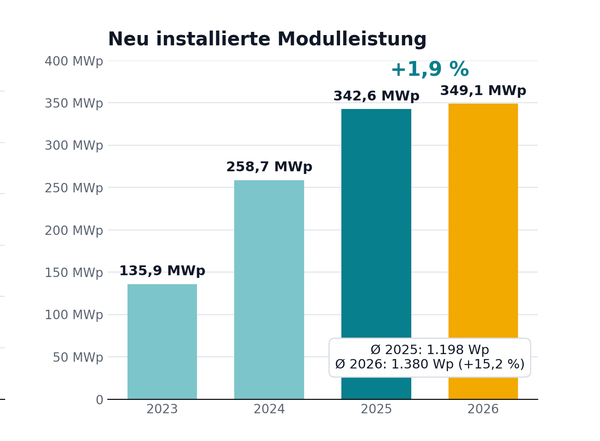
Also known as plug-in solar (Steckersolar), not only has the total number of systems increased nearly 50% from last year, but also the capacity of each solar module has increased from 343 watts to ~350 watts. Similarly, system size has increased from 1.2 kW to ~1.4 kW, suggesting consumers are now installing four panels for each system. Previously, consumers installed only two panels each.
Under rules implemented in May 2024, Germans can install up to 2 kW plug-in solar systems without an electrician, or permits. However, systems are limited to delivering no more than 800 W to the plug. Prior to 2024 most plug-in solar systems were only 600 W.
The landkreis or county of Friesland in Germany’s far northwest corner has the highest concentration of plug-in solar systems with 3,400 units, representing 34 systems per 1,000 inhabitants. Friesland, on the west coast of the Jutland peninsula, has also the highest concentration of wind energy as well.
In 2025, renewable energy supplied 56% of Germany’s electricity. Germany’s top renewable energy supplier was wind energy (28%), followed by solar (19%).
Several states in the US now permit plug-in solar led by red state Utah, followed by blue state Vermont. California, the country’s largest solar market passed legislation making balcony solar legal this past summer, but it has yet to be signed by Governor Newsom. Legislation is pending in a dozen more states.
