I’ve previously written about the history of Wind Harvest’s Vertical Axis Wind Turbine from the mid 1970s. (See Wind Harvest VAWT—a Jungian Vision (the Backstory). Recently, Dean Thomas, the son of Wind Harvest’s founder Robert Thomas, contacted me with more on the history of the turbine’s development from someone who was there at the creation.
Here is Dean’s commentary on the period.
I appreciated reading nuggets of Wind Harvest Co’s history that you have posted. I wanted to offer some additional history, clarification, and names that deserve recognition. The original founders of the company include my father (Robert Thomas, president), along with George Wagner and Sam Francis, the famous artist you mention. The three original founders met at the Jungian institute and were friends but all three have since passed away. All three were strong environmentalists and believed wind energy could offer a sustainable alternative to fossil fuels and nuclear power. My father was an aeronautical engineer (degree from University of Michigan), and George (an attorney for California League of Conservation Voters among other things) was the chief fund raiser. One of my father’s previous jobs was as a civilian engineer at the US Navy’s China Lake Naval Weapons Station where he designed missiles (a “rocket scientist”). His wife, Rosalind Thomas, encouraged him to return for and advanced degree at UC Davis to pursue his interest in wind energy and that is when he left the war machine in the early 70s. In the late 70s, the first serious Windstar prototype turbine (3-5 KW size, stacked rotor module) was installed at the Bald Mountain weather station, south of Gorman. Jeff Ball (deceased), a recent physics graduate from UC San Diego, built all of the parts, including steel and blade structure made from welded galvanized fence post material in a lattice framework, and bearings from used car axles. The blades consisted of aluminum skin riveted to corrugated aluminum backing. I remember several episodes of helping replace rivets in the blades that came loose as a result of oil canning. I was in high school at the time. The early design philosophy came from my dad’s experience being raised on a farm in northern Michigan- “keep it simple, stupid (KISS principle)” and a dream he had of the pentagon star shape that became the superstructure of the augmented VAWT gyromil “Windstar.”
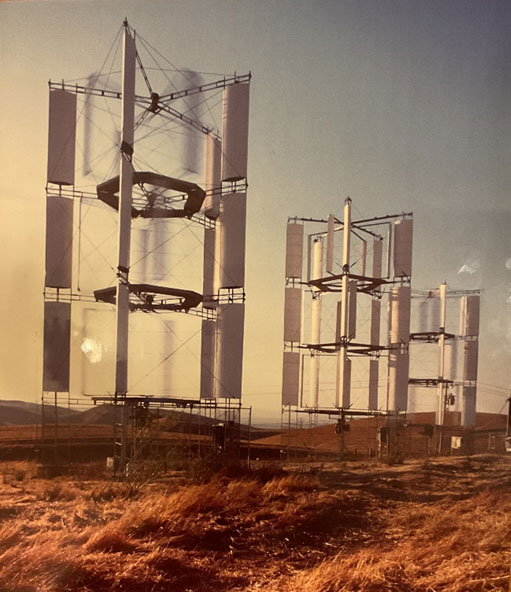
While my father was working at the California Energy Commission (CEC) in the wind energy program (he was asked to lead the program being one of the only people with wind energy experience in California at the time) under Jerry Brown, we moved back to Davis, Ca. along with Wind Harvest Co’s shop. Jeff Ball built 3x-25 KW turbines consisting of three stacked rotor modules (see attached figure), four blades each rotor=33% solidity, with similar construction as the one on Bald Mountain. I helped install them in the hills between Concord and Pittsburg. While in college at UC Davis studying geology, I spent many hours monitoring and maintaining the turbines during the summer and weekends during the early 80s. Again, we had to replace rivets on numerous occasions on the handmade blades, climbing up to 40 feet to do so. I encouraged my dad to try fiberglass blades to see if performance could be increased and maintenance reduced. George raised the money and the center turbine was outfitted with fiberglass blades (NACA 0018 profile). The gearbox was instrumented with load cells to measure mechanical torque versus windspeed. Results were recorded on a Tandy computer (one of the first laptops). I helped calibrate the load cells by hanging known weights and adjusting the readings. Ben Parks, electrical engineer (also involved with the State’s wind energy program), designed the monitoring system and controls. Results were favorable (25% improvement), with peak mechanical efficiency approaching the Betz limit, owing to higher lift and lower drag of the augmented rotor (see attached figure). The pitch mechanism and bearings still needed improvement, along with beefing up the superstructure. While my dad was still working at the Energy Commission, he hired Bill Dakin to manage operations while I attended college. Kevin Wolf started to get involved with Wind Harvest Co. at this time, as I recall (he is the current CEO of Wind Harvest International [WHI]). An important accomplishment of CEC’s wind program was the anemometer loan program whereby California’s wind resources at 10 meters began to be characterized. Dad also encouraged Danish wind technology to be imported to California because it was further advanced and more durable than US technology for utility- scale turbines.
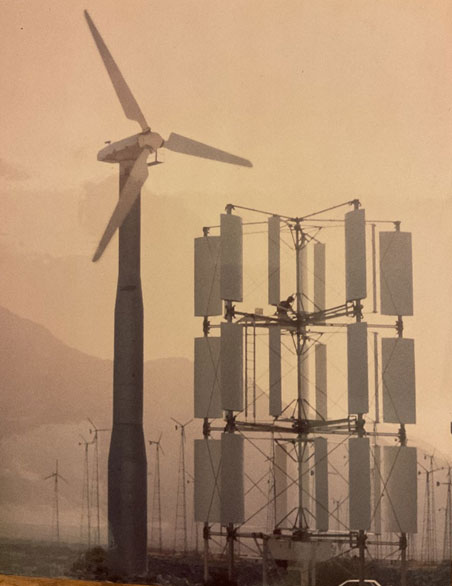
“Encouraged by the good performance, we fabricated a fourth 25 KW Windstar turbine in the Davis shop for a site in Antelope Valley. Improvements included a better blade pitch mechanism (centrifugal) where all four blades in the module pitched at the same time and the superstructure was made stronger and stiffer after review by a licensed civil engineer. Dad left the State to focus full attention at Wind Harvest Co. and moved the family and the shop back to Ventura in the mid-80s. I graduated from UC Davis and began working full time for Wind Harvest Co., assuming the role of field engineer and draft person/designer. To reduce costs of the augmented turbine, the next two turbines were manufactured in China and we installed them at Wintec’s site at Whitewater in the center of San Gorgonia pass (a 14-15 mph average site at 10 meters-see photo of me on the third module) in the late 80s. This was entering the “big leagues” of wind, not quite the energy of punishing winds on the Alta Mesa (17 + mph average), but days that blew sand in your face were experienced during peak season. We had some respectable months of energy generation (over 7000 KW hrs. for a 525 square-ft rotor); however, we got a heavy dose of “Murphy’s Law.” Not knowing the loads on each blade, we under-designed the blade support arms and they experienced a failure at a joint weld that had corroded. During this time dad focused on designing a 50 KW-single module turbine (1066 square ft. swept area), with the goal of reducing parts and the specific weight of the turbine via “pitch-able” exterior stators. This turbine was installed next to the Chinese turbines and ran well up to 30 mph winds but the structure was too elastic for continuous running. We did not have the tools that are available now for modeling dynamic wind loadings, which would have helped. The site was sold and Wind Harvest Co. was forced to take the turbines down. I returned to school at UC Riverside in pursuit of a MS in geology but continued to help WHC occasionally over the next 3 decades while working in the environmental field as a hydrogeologist.

In the 2000’s, dad being leery of larger turbines, designed a guyed 25 KW (525 square ft. swept area) non-augmented version of the Windstar, and installed three closely-spaced turbines at Wintec’s north Palm Springs site. The guyed structure reduced the steel and cement weights needed for permit. He obtained a patent for the “Dual Vortex” concept for the measured increased performance (15-20%) of the counter-rotating turbines that partially made up for the lack of augmentation and lower performance experienced by a single turbine. Thirty-three percent solidity was maintained because of self-starting feature. Dad also achieved several other patents, including one for coupling blade pitching (aerodynamic braking) to the disc brake mechanism.
