Fayette Energy Corp., the troubled Altamont Pass operator of a 143 MW wind plant plagued by debt, a low-paying avoided cost contract, and an unproductive, failure-prone wind turbine, appears on the verge of rebirth. After paying off more than $30 million in debt, and settling scores of legal disputes, Fayette signed an agreement 3/19 with SeaWest for 24 MW of Standard Offer #4 contracts.
1 June 2025: While archiving articles I’d written for the American Wind Energy Association’s newsletter, Wind Energy Weekly, I came across this one about Fayette’s restructuring in 1990. At the time I was the west coast representative for AWEA in Tehachapi. There’s not a lot on my web site about Fayette. (I do mention them in my books and in articles on capacity factor and how this figure of merit can be so misleading.) Consequently, for historical reference I am posting the article with the original date that I submitted it to AWEA.
“Fayette has turned the corner,” says Dwight Kuhns, Fayette’s vice president. “It’s a story of a big wind company that hit bottom” and survived, says Kuhns. Fayette president, John Kuhns, says he’s nearly completed restructuring every phase of the company.” The company is now profitable,” boasts John. “We now want to go out and help others.” John, founder of the pioneering independent energy producer Catalyst Energy Development, believes the Kuhns’ success with resurrecting Fayette puts them at the forefront of those seeking solutions for other wind companies in a similar plight.

Now down to just a skeletal crew, Fayette will not operate or service their own turbines. Instead Fayette has signed an agreement with SeaWest for operation and maintenance of Fayette’s machines. In turn SeaWest takes control over much of Fayette’s remaining service equipment. SeaWest will service “not less than 400” turbines and up to as many of Fayette’s 1,418 turbines Fayette can bring on line. All but 48 of the turbines were manufactured by Fayette.
Fayette’s legal and financial problems were compounded by their choice of technology. The Fayette turbine grew out of a design by a Pennsylvania backyard inventor during the late 70’s. With interest in wind development reaching a fever pitch in California during the early 80’s the turbines were sought after despite the failure of all the prototype turbines erected in Pennsylvania’s coal country. Eventually ex-CIA researcher John Eckland bought the company and moved its manufacturing operations to the Altamont Pass. The strong demand for turbines–any turbine–and an aggressive sales program pushed Fayette to the number two position in California’s wind industry.
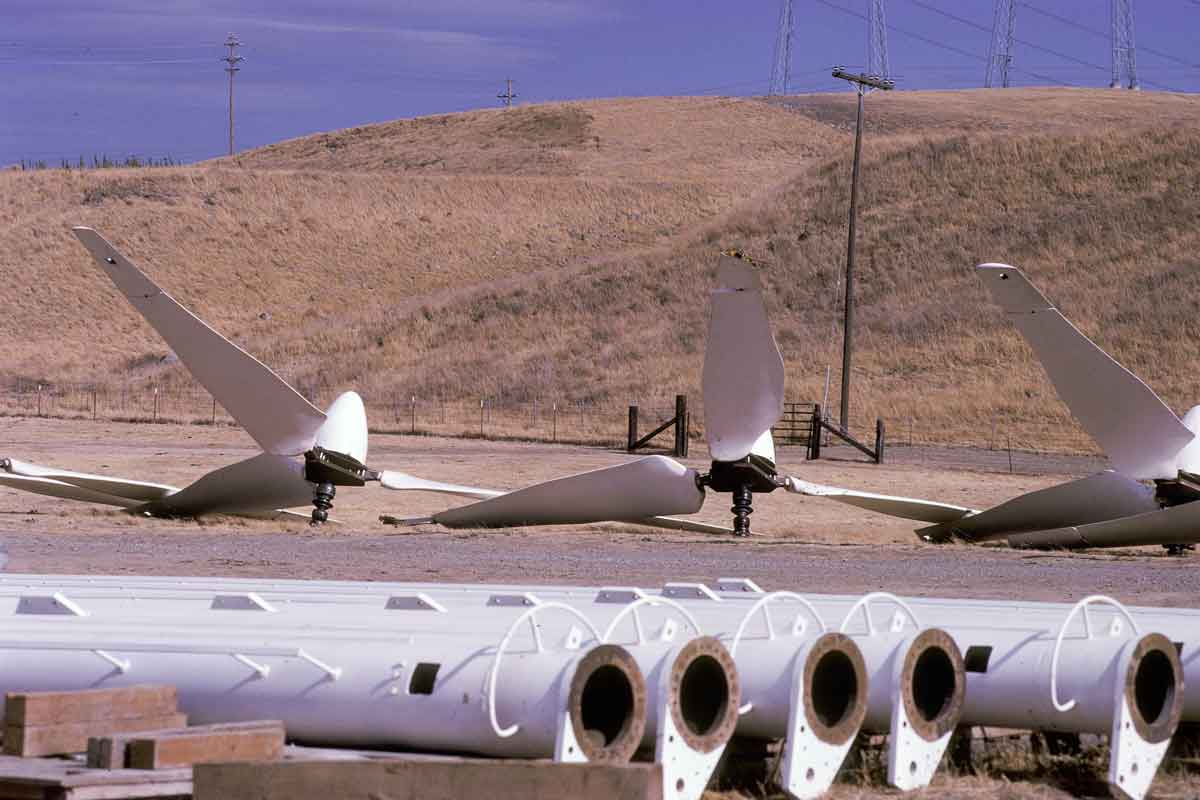
By all standards the turbine did not perform as well as other machines on the market–by as much as a factor of four. Fayette’s standard turbine used a three-bladed rotor about 10 meters (33 feet) in diameter to drive a 95 kW generator. Comparable turbines by other manufacturers powered 25 kW generators. Though the turbines were sold based on a competitive price in dollars per installed kilowatt, they were considerably overpriced based on the generation the turbines were likely to produce from a 10-meter rotor. Not only did the turbines not deliver as much energy as a comparably priced turbine, the Fayette machines encountered numerous technical problems from the start.

Fayette’s near fatal blunder, though, was not acquiring S.O. 4 contracts. When oil prices collapsed payment for what little the turbines were producing also fell. This further eroded the firm’s ability to operate and maintain the machines. And without the S.O. 4 contracts Fayette couldn’t expand any further. By 1988 Fayette had fallen to fourth place in the state for installed capacity. Without expansion, Fayette couldn’t attract new capital to repair the existing turbine stock. Fayette was trapped.
The firm generated only 66 million kWh during 1988. By nearly all measures Fayette ranks near the bottom of California’s wind industry. They had the lowest capacity factor of any major operator, 5%; the lowest relative productivity, 444 kWh/m2; and the lowest percentage of projection, 31%.
Industry observers have anxiously waited for the curtain to fall on the Fayette drama expecting that the company’s messy demise would be another blow to wind energy’s credibility. When the Kuhns brothers entered the picture Fayette was “rapidly approaching the brink.”
Finally Fayette’s founders sold the company to the Kuhns in December 1987 to pay off a lien by the Internal Revenue Service for $17 million. Since then the Kuhns have been paying down the company’s debt and “settling lawsuits by the dozen.”
Unlike most transactions in California’s wind projects, Fayette investors bought individual turbines. The investors assumed all the risk that their particular turbine would perform well at the site where it would be erected. In limited partnerships, the technical and siting risks are dispersed over the partnership.
Most Fayette investors bought their turbines with a sizable non-recourse note. It is these notes that are fueling Fayette’s revival. Kuhns called upon the investors who owned their turbines to exchange them for shares of the new Fayette. According to John Kuhns, 90% of those who owned their turbines outright signed up. “Lesser amounts” participated in other investor classes. Those who didn’t yet own their turbines had to first pay off their notes before joining the exchange.
John Kuhns argues that it was in the investors’ best interest to sign up because many were loosing money on their turbines. By spreading the risk they would also share in the benefits. “They get shares of a company that makes money,” says Kuhns instead of a turbine that may or may not.
The transaction is a further sign that the industry itself may have turned a corner. Not only are utilities, through their unregulated subsidiaries, now investing in wind energy, but a company that many had written off years ago as unsalvageable is returning to life.
But it is unlikely that all of Fayette’s turbines will be in operation soon, if ever. Fayette will only operate selected turbines. “We can choose not to operate the turbines” if we don’t want notes John Kuhns. Instead, he prefers to spend money on the turbines that work, in the places where they work best. In the process “we may need to reassess the location of our turbines,” he says.
Nevertheless, returning as many of Fayette’s machines to regular service as possible can not help but improve the perceptions of those who drive by on I-580 and those who watch the industry from a far.
