Don't do this at home. Two men standing on one of two blades on the Smith Putnam wind turbine atop Grandpa's Knob near Rutland, Vertmont in 1941.

The York County History Center’s Virtual Exhibition of the Smith-Putnam wind turbine has gone live. Opening with a stunning photo of five men standing on one of the two blades after the giant turbine was installed in Vermont in 1941. The exhibition celebrates the 80th anniversary of the 175-foot (53-meter) diameter wind turbine feeding electricity into the grid—a first in North America.

Rotor Assembly p. 122 of Palmer Putnam's Power from the Wind. "The completed blades were then shipped to the Cleveland plant of the Wellman Engineering Company, who fabricated the remainder of the structure, and shop assembled the whole, statically balancing the blades and the rotating system before shipping to Rutland in the spring of 1941."

19 October marks 80 years since testing began of the 1.25 MW Smith-Putnam turbine on Grandpas’ Knob near Rutland, Vermont in 1941. To mark the occasion, the York County History Center in York, Pennsylvania is opening its digital exposition Tuesday, 19 October. The S. Morgan Smith Company, of Smith-Putnam fame, manufactured hydroelectric turbines in York, Pennsylvania before it ventured into wind energy.

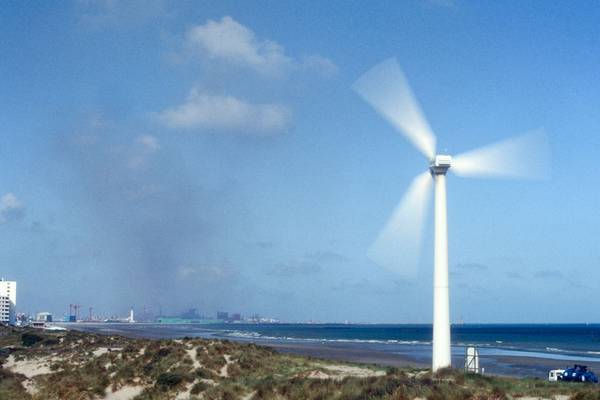
Espace Eolien Developpement Windmaster 25 meter turbine on the digue at Dunkerque, France in the early 1990s.

La Puissance du Vent: Des moulins á vent aux éoliennes modernes by Philippe Bruyerre is a major work on the history of wind energy particularly in France, but also elsewhere. His book earns a place in French analogous to Matthias Heymann’s masterwork on German wind energy or Rinie van Est’s Winds of Change.

The following are the bibliographic entries I’ve been able to uncover for Dimitri Stein, a German-American engineer who studied wind energy in the mid 1940s. He and the company he started with others designed and built a 15-meter diameter wind turbine for a remote island in 1949.

While traveling in Belgium the day after hearing about Wobben’s death, his direct-drive Enercon turbine heritage was prominently visible along the way. The turbines’ characteristic egg-shaped nacelles makes them easily recognisable, together with the unusual high-performance blade design featuring tip winglets and a widening spoiler towards the aerodynamically optimised spinner.

Another visual characteristic is the slender prefab coning of the often concrete-steel hybrid towers with their patented colour scheme in different shades from dark green to lighter colours towards the white-grey upper structure.

Google satellite view of the German Windpower Musuem in Lower Saxony.

I’ve just learned that an open-air museum of wind turbines in Germany has expanded its collection to include two US-built machines. I hope to get there some day–once Covid-19 has lifted. Nothing like kicking iron if you’re into windmills.

View of Rhodes (i. e. Rhodos, Rhodus), capital of the Greek island of the same name, around 1490. The realistic details are noteworthy; e.g. the windmills around the town, esp. at the seaside. Woodcuts by Michel Wolgemut, Wilhelm Pleydenwurff (text: Hartmann Schedel). This work is in the public domain in its country of origin and other countries and areas where the copyright term is the author's life plus 100 years or fewer.

In response to my article Who Built the World’s First Wind Farm? Thomas Leitlein argues that it was the island of Rhodes off the coast of Turkey in the Aegean Sea. He makes his case below.

Rtemagicc gedser mill video icon kristian nielsen 01 jpg jpg

As interest in the Smith-Putnam project heated up, a colleague directed me to a video of the famous mill at Gedser in Denmark. It was at Gedser where the modern wind industry began.

SmithPutnam6055

Because of increasing historical interest in the Smith-Putnam wind turbine, I’ve added two new pages on the Project: patents for … Read more

Hoopers squirrel cage VAWT late 18th century, Margate.

Ok, I am a windmill geek, have been for decades now. I work with modern wind energy, but my interest in the subject has led off in many directions, including traditional or “Dutch” windmills. I have a hefty collection of books on Dutch, German, French, and, yes, on English windmills.