In The Wake of Wind, is a powerful 33-minute color film that tells the dramatic story of the rise of the British wind industry and its eventual fall.
With original music by Chris Evans Roberts, producers Alex and Duncan Robertson set out to answer the question of why today there’s no British manufacturer of wind turbines. They trace the story of the Wind Energy Group by interviewing a Who’s Who of British wind technology, including John Armstrong, David Lindley, Peter Simpson, Charles Anglin, Peter Fraenkel, Andrew Garrad, Richard Lord, Rob Sauven, and Dave Venning.
The film moves chronologically from the development of the first modern wind turbines on the wind swept moors of Great Britain to diving beneath the sea with tidal turbines derived from the very same technology.
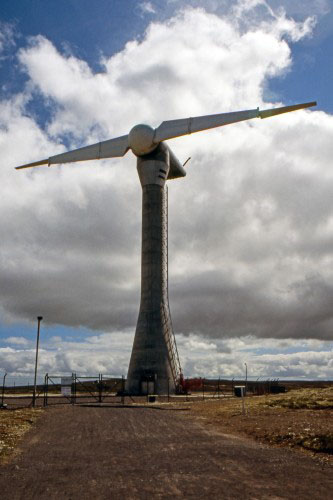
Sometime between 1978 and 1979 David Lindley convinced British Aerospace, Taylor Woodrow, and GEC to form the Wind Energy Group (WEG). The company then won a contract with the United Kingdom’s Department of Energy to design a 3 MW, 60 meter diameter wind turbine for one of the windiest sites in Great Britain, the Orkney Islands, where the average wind speed was 10 m/s (22 mph).[1]
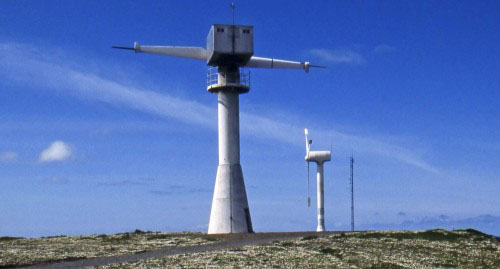
Before the LS-1 or Large Scale wind turbine was completed, WEG determined that it might be wise to build a smaller turbine first to gain experience. This became the MS-1, an ungainly “Medium-Scale” turbine with a 20-meter rotor. Both the LS-1 and the MS-1 used pitchable blade tips rather than blades with full-span pitch control and both were installed near each other on the same site in the Orkneys.
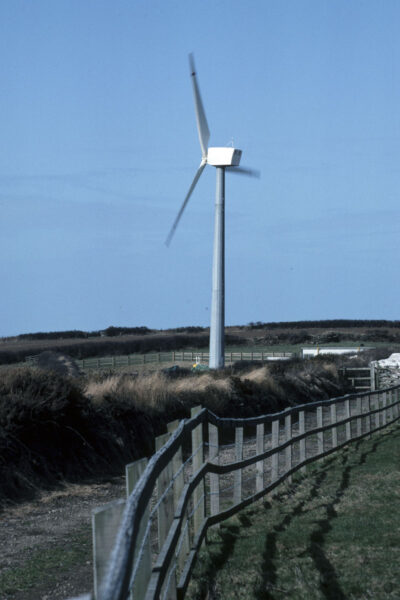
Subsequently, WEG designed the 250-kW MS-2, and installed a prototype in 1984 near Ilfracombe in Devon. The turbine was novel at the time. The 25 meter (82 foot) diameter, three-blade rotor used full-span pitch control and the blades were made out of wood composite.
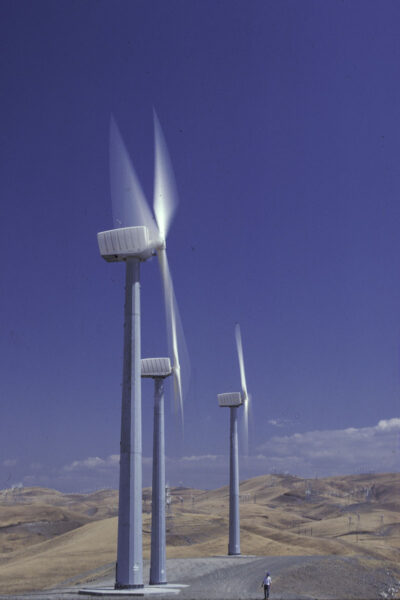
This was the period of the California wind rush and WEG didn’t want to be left out. WEG installed twenty of the MS-2s in the Altamont Pass in 1986. These remained in operation for nearly three decades before they were removed in 2015. WEG’s MS-2 was by far the most technologically successful of the few variable pitch wind turbines developed during the 1980s, though US Windpower had installed literally thousands more of its 56-100, a 17-meter diameter 100 kW wind turbine, than WEG.
WEG concluded that the MS-2 couldn’t compete with Danish machines so set about designing the MS-3 to be more competitive. The MS-3, a 300 kW turbine, used two teetered blades again fabricated from wood composite. The 33 meter (108 foot) diameter rotor swept nearly 75% more area of the wind stream than the previous MS-2.
A prototype MS-3 was installed at Britain’s test site in Carmarthen Bay, Wales in 1988 and another unit in California’s Altamont Pass.
By then Lindley had moved on to National Wind Power and proceeded to build three wind farms with the MS-3, Cemmaes and Llandinam in Wales (1992), and Cold Northcott (1993) in Cornwall. At the time there were as many as 150 people working at WEG.
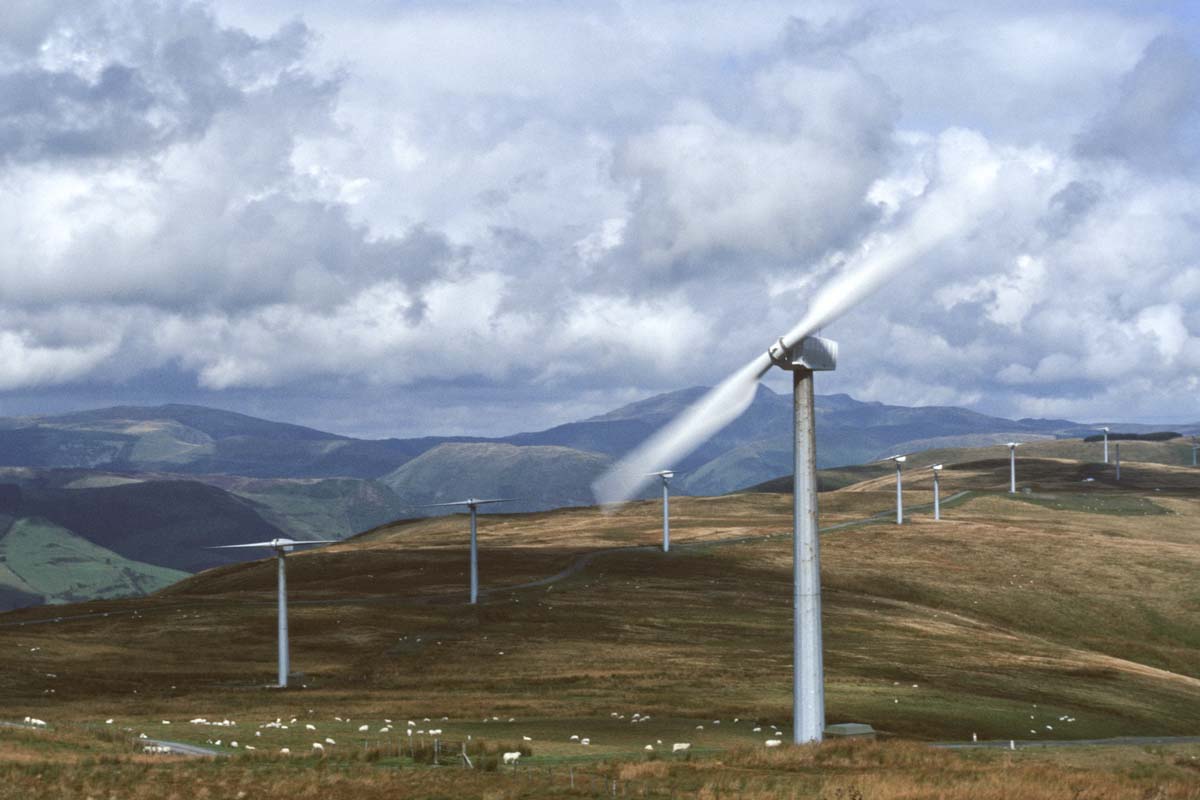
Then disaster struck in 1993 when a severe storm hit Wales and some of the turbines on Cemmaes Ridge lost their rotors. Lindley notes that the storm exceeded 70 m/s (~160 mph) before the anemometer was destroyed. The wind was so strong that some of the transformers were moved about their pads.
WEG redesigned the rotor and the new machines survived a similar storm the following year.
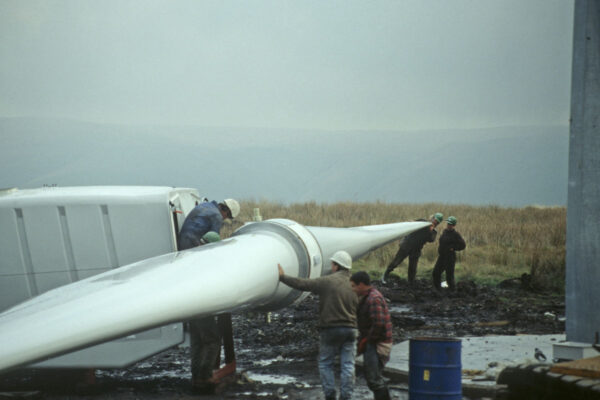
The company looked at stretching the design further until they decided to abandon that approach and opted for a far more radical design: a downwind, highly flexible, three-blade rotor that would shed load.
Unfortunately, the home market in Great Britain never developed like it had in Denmark and Germany where there was a steady demand by farmers and cooperatives. British projects, in contrast, were often delayed by opposition that stymied development—and has to this day.
Only 0.5% of the Non-Fossil Fuel Obligation, created by the Thatcher government to support nuclear power, was spent on wind energy.[2]
From 1978 to 1998 WEG developed six prototype wind turbines and sold a total of 80 machines. It wasn’t enough. WEG eventually was sold with the blade technology on the Isle of Wight being used by Danish manufacturers for a time.
Both Andrew Garrad and David Lindley suggest that WEG might have been more successful if they had developed the three-bladed MS-2 further and not gone down the track of the two-bladed MS-3.
The film closes with a prophetic question, “Do we want to make the mistakes of the past” relative to the development of British tidal power technology. The answer, I am afraid, remains moot.
[1] E. W. Golding, The Generation of Electricity by Wind Power, Reprinted by John Wiley&Sons 1976 (E. & F.N. Spon, 1955), page 158, Table XXVI identified Costa Hill, Orkney as one of the windiest sites in the British Isles with an average annual wind speed of 11.2 m/s (25 mph). In the mid 1950s, John Brown Engineering installed an experimental 50-foot diameter, 100 kW wind turbine on the site.
[2] In the early 1990s, I wrote this passage about NFFO in my book Wind Energy Comes of Age on pages 43-44. “The Thatcher government conceived the Non-Fossil Fuel Obligation (NFFO) to prop up Britain’s ailing nuclear industry, which generates 20% of England’s electricity, by guaranteeing it a market at premium prices. The NFFO requires (obligates) the regional electricity companies (RECs), which buy and distribute electricity, to provide a portion of their supply from nonfossil sources, that is, from nuclear power. The RECs buy this portion at a premium price and pass the cost along to their customers. The NFFO applies only to English and Welsh RECs, with special provisions for Scotland. However, the government overlooked a subtle detail: Wind energy is also a nonfossil resource. Accordingly, a special tranche of NFFO was created for renewables, with a goal of 1500 MW by the year 2000. Of the 11% NFFO levy on utility bills in 1993 1% went to renewables, the rest to nuclear. In the initial awards, landfill gas, biogas, and incineration took 80% of nonnuclear capacity.” Paul Gipe, Wind Energy Comes of Age, The Wiley Series in Sustainable Design (John Wiley & Sons, 1995), Internet Archive, https://archive.org/details/windenergycomeso00gipe/page/n7/mode/2up.
