While giving a presentation on how to use EVs in front of an oil industry friendly audience of retirees, I was accused of being a free rider by not paying for maintenance of California’s roads because I drive an EV.
For background, consider that Bakersfield is an oil town. Kern County, of which Bakersfield is a part, is number 1 in California oil production, pumping three-quarters of all oil in California, and 16th in total US oil production.
While EVs are not an uncommon sight on the roads of Kern County, they represent less than one percent of the two million EVs in the state. In other words, pushing EVs in Kern County is not the way to win friends and influence people.
The growth of EVs poses an existential threat to the oil industry here—and they know it. Sales of fossil burners peaked in 2017 and the trajectory is a steady, if not slow, decline. (See Hallelujah We’ve Passed Peak Gassers–Combustion Vehicle Sales in Terminal Decline.) The industry can see the handwriting on the wall and they aren’t happy about it.
Naturally then, the industry seeks to denigrate the role of EVs to stave off their acceptance and keep the good times rolling. One common criticism here is that EV drivers don’t pay their way. They are “free riders” on the backs of hard-working, All-American, gasoline consumers who pay both federal and state taxes on each gallon of gas sold. And in California they pay a whopping $0.70 per gallon, among the highest in the nation.
To some extent the charge is true. (All good propaganda begins with a kernel of truth.) EV drivers don’t pay the “gas tax” because, well, they don’t use gas–that’s their whole point.
California, to compensate, charges EVs with a Road Improvement Fee (RIF) of $120 (2025) on all model year 2020 and later zero emission vehicles (ZEV).
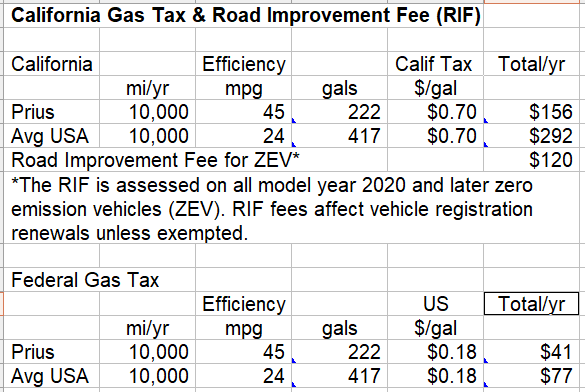
The fee we paid for our EV ($120) is somewhat less than what a Prius driver would pay ($156) in California gas tax per year, and less than half of what a driver would pay annually for an inefficient car with the average US fuel economy.
So, no, we’re not getting a free ride driving an EV. We’re paying less, but we’re paying about what a more efficient plug-in Prius driver would be paying.
The people who are getting a nearly free ride are the trucking companies. They are the ones who damage the roads not passenger vehicles. And their lobbyists are always trying to foist more of the cost of our roads onto passenger vehicles. In contrast, railroad freight haulers have to pay for their road bed.
And in a parting shot at EVs, the critic in the audience noted that “EVs are heavier too.” Yeah, they are, but not by much. I’ve written about that FUD before. (See Weight of EVs Will Crush the World—Not.)
Again, the weight of EVs and passenger vehicles in general pale in comparison to that of heavy trucks. So the “EVs weigh more” is another red herring.
Alternatives to the Gas Tax
California, to address the perceived imbalance between EVs that don’t pay a gas tax and gassers that do, has proposed changing to a fee based on the mileage driven each year. Caltrans ran a test of this proposal several years ago and it appears that the idea has since died on the vine. (See Road Charge Collection Pilot.)
Others, such as Youtube influencer Eric (1%) Way, have proposed shifting to a fee based on vehicle weight. This would more accurately reflect the wear and tear of the roadway as it’s a function of vehicle weight. (See A Fair EV Road Tax: My Modest Proposal.) I imagine the trucking industry would have something to say about such a proposal—even if it’s the fairest proposal out there.
For now, California’s Road Improvement Fee has dampened the EV free-rider debate. EV critics will have to move onto something else to inflame the pitch-fork wielding mob. Maybe fires, the “grid will collapse” or they’ll bring back radiation poisoning from the battery’s EMF. They’re nothing if not creative.
- Mythbusting: Electric Car Drivers Don’t Pay Road Taxes
- EV drivers in 36 states pay a surplus of fees each year
- State Gas Taxes: What They Are And How Much You Pay by Nerd Wallet
- Road Charge Collection Pilot by Caltrans.
- A Fair EV Road Tax: My Modest Proposal by Eric Way.
- Are EV Taxes Just Paying Our Fair Share? by Kate-Walton Elliott
- California Road Improvement Fee (RIF)
- Trucks Cause the Lion’s Share of Road Damage—and Their Industry Wants You to Keep Paying for It
- The User-Pay Myth: We ALL Pay for Our Roads, Not Just Drivers
- Is the Way We Pay for Transportation Equitable? We Take a Close Look
- Weight of EVs Will Crush the World—Not
- EV taxes and highway funding: Setting the record straight
- The hidden cost of road maintenance due to the increased weight of battery and hydrogen trucks and buses—a perspective
