We completed another 1,500-mile road trip this time to Crater Lake and Lassen National Parks. We’ve taken this route north on I-5 before and we now have our preferred stops and know where we want to take breaks either for coffee or for lunch.
The new Bolt and the plethora of stations on the I-5 corridor have changed the way we travel with an EV. The car no longer dictates the stops and the length of the stops. We want to stop before the car needs to stop and the car charges so fast I no longer wait on it. Now I plug in and walk away for coffee, a potty break, or lunch and just let the car charge.
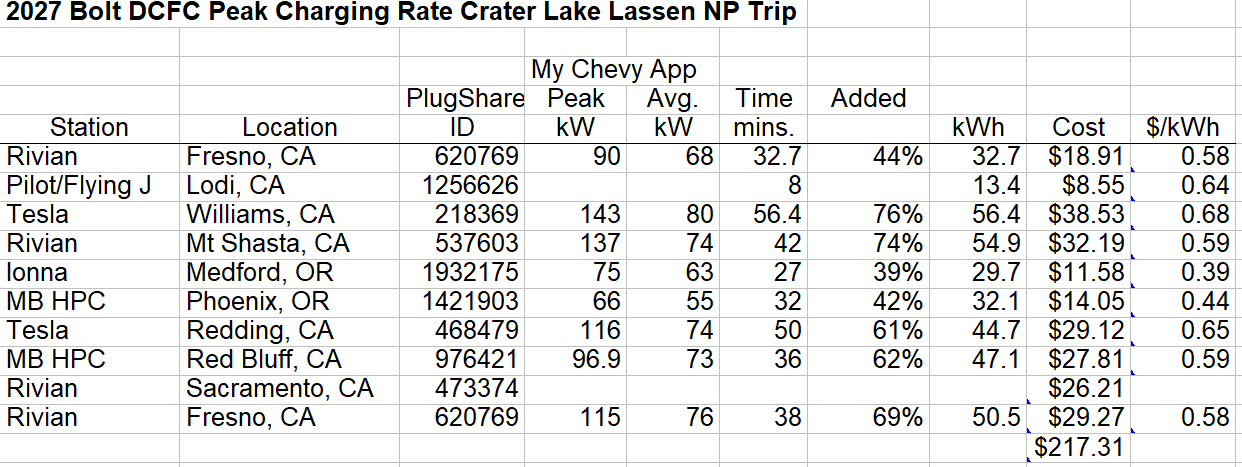
With the exception of the Tesla station in Williams, California, all the stations were only lightly being used so there was no one waiting on us to unplug. Even in Williams during the noon rush, there was no one waiting on our stall despite charging for nearly an hour and gaining 56 kWh while we ate our lunch at Granzella’s.
While most drivers focus on the peak charge rate, the average rate tells you more about how many kWh you can pump into the car over time. The average charge of the new Bolt is often 70 kW to 80 kW. The average rate for the Tesla station in Williams, where we charged almost an hour, was 80 kW. That’s impressive, particularly in comparison to the peak charge rate of the first generation Bolt of 55 kW.
As others have noted, GM’s MyChevy app doesn’t update the history section completely, leaving some holes in the data.
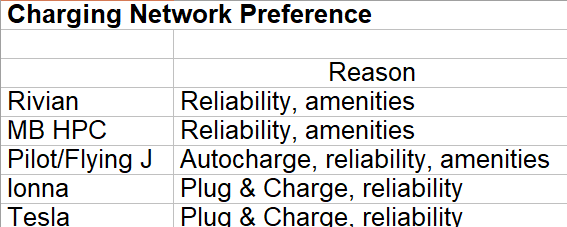
Network Preferences
On this route, my preference of charge networks is based on plug & charge convenience and amenities. All the networks we used were reliable and worked on the first try. There are very few Ionna stations on this route and those that exist have few amenities. Pilot/Flying J has Autocharge but only CCS connectors, requiring an adapter. Rivian and Mercedes Benz HPC don’t have plug & charge but are often co-located with amenities. In the case of Rivian, the Fresno station is next to an excellent French pastry shop, the Sacramento station adjoins an REI store, while the Mt Shasta station is in a quiet location surrounded by pine trees within sight of Mt. Shasta. Picnic tables are nearby and so is a Black Bear diner. The MBHPC stations on this route are co-located with Starbucks, always good for a break. While I try to avoid Tesla, it does have plug & charge convenience, though often with very short cables, necessitating some careful manuevers. My wife wanted lunch at Granzella’s where the Tesla station is directly across the street from the restaurant so that dictated the stop in Williams.